

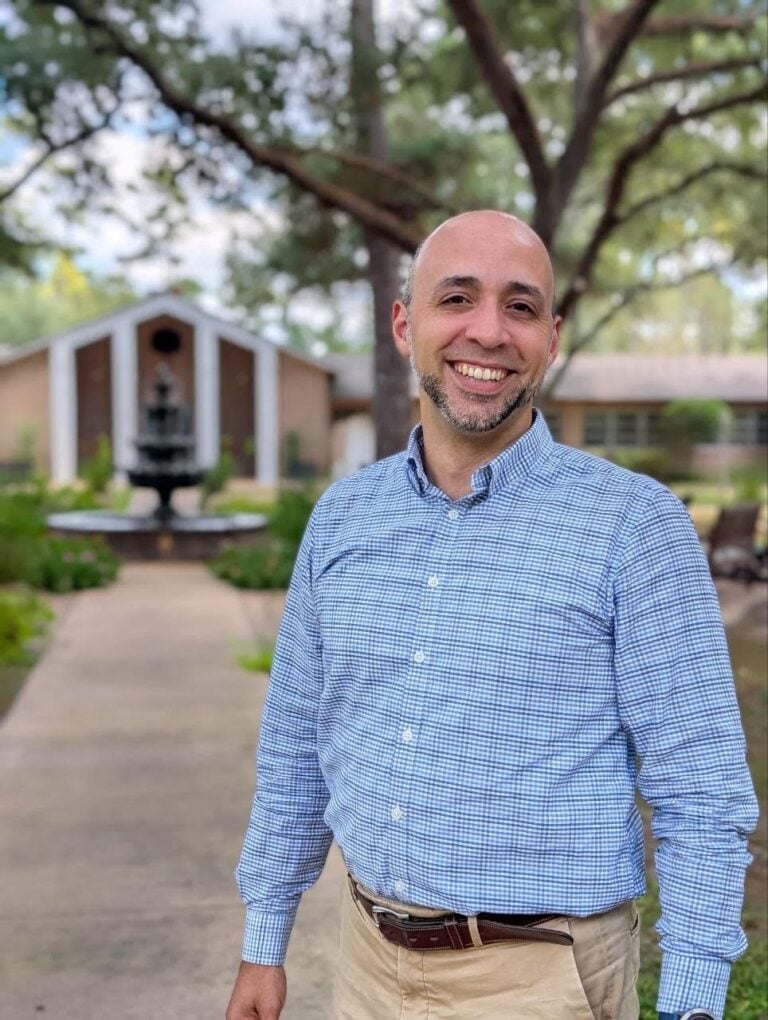
Como el nuevo presidente de la Catholic Theological Union (CTU) en Chicago, Illinois, el Padre Enzo Del Brocco, CP, encabeza una institución educativa que forma a hombres y mujeres en la comprensión de la teología y la fe. El Padre Enzo, miembro de la provincia San Pablo de la Cruz, ha trabajado en distintas partes del mundo compartiendo el amor de Cristo.
La esperanza es parte esencial de su vida y de su ministerio, y ha sido testigo del poder que trae la esperanza en algunos de los lugares más pobres del planeta.
“Creo que la oración es verdadera cuando se convierte en acción. Nuestra esperanza no sale de un sueño ni de algo falso”, explica el Padre Enzo. “Jesús crucificado es nuestra esperanza. La cruz es nuestro ancla. Ese ancla detiene el barco para que no sea arrastrado por las olas.”

Para él, la esperanza es el primer paso para cambiar el mundo.
“La esperanza hace posible que la oración y la acción se vuelvan verdad y realidad”, dice el Padre Enzo. “La esperanza es necesaria en este momento para quienes están siendo marginados. Es esencial porque nos da el valor de seguir adelante.”
“Tenemos que pasar esa llama y darle esperanza al mundo.”
P. Enzo del Brocco, CP
Frecuentemente, el mundo parece sumido en el caos y la ira, pero la esperanza nos da el poder de marcar la diferencia.

“Cuanto más oscura es la noche, más necesidad hay de luz. Cuando realmente está oscuro, una simple vela ilumina mucho,” comparte el Padre Enzo. “En este momento en que la oscuridad parece dominarnos, es hora de encender nuestras velas de esperanza. Tenemos que pasar esa llama y darle esperanza al mundo.”
El Padre Enzo considera el Año Jubilar de la Esperanza como una oportunidad para actuar.
“Este Año Jubilar es dedicado a la esperanza, pero no solamente como tema para eventos públicos, sino para animar a cada uno de nosotros a superar el miedo o temor. Siempre habrá miedo alrededor de nosotros; eso es lo que el mundo intenta provocar. La única manera de vencer el miedo es con esperanza, porque la esperanza nos da valor. Tener esperanza no significa ignorar la realidad; significa tener la capacidad de desconectarnos del miedo. El miedo desaparece cuando sabemos exactamente a qué nos enfrentamos y que podemos enfrentarlo. La esperanza nos da esa energía para actuar y aprender. Tengo muchísima esperanza en Dios.”

La oración es clave en la manera en que el Padre Enzo cultiva la esperanza.
Leer las Escrituras y meditar en la Pasión de Cristo crea una base sólida para afrontar los desafíos personales.
“He visto la esperanza emanar de las personas y lugares más imprevistos”, comparte el Padre Enzo.
Algo que debemos recordar, señala, es que todo toma su tiempo.
“El resultado positivo no se da de inmediato. Así no es. Hay que poner la esperanza en un panorama más amplio”, explica. “Por ejemplo, si meditas en la Pasión de Jesucristo, cuando te das cuenta del alcance de la esperanza, comprenderás el sentido de tu vida.”
El Padre Enzo cree que la atención del mundo suele ser engañoso. Sin embargo, los cristianos estamos llamados por nuestra esperanza y fe, no solo a reconocer qué actitudes y acciones deben rechazarse, sino también a descubrir cómo podemos participar en la renovación del mundo.
“Vivimos en un mundo en que la gente se pregunta: ‘¿Cómo puedo ganar más poder? ¿Cómo puedo rendir mejor? ¿Cómo puedo ser más atractivo?’”, dice el Padre Enzo. “Pero la medida de éxito para Dios es el verdadero progreso; avanzamos el verdadero progreso cuando nos unimos para buscar soluciones reales. En las batallas más profundas de la vida, las respuestas no se crean con un tuit.”
“La única manera de vencer el miedo es con esperanza, porque la esperanza nos da valor.”
P. Enzo del Brocco, CP
Orientar nuestras vidas con esperanza no es fácil. Requiere abrir los ojos al sufrimiento de los demás y ser constante incluso en los momentos más difíciles.
“La esperanza no siempre consiste en decir algo reconfortante”, comparte el Padre Enzo. “Dar esperanza significa tomar la mano de quien está muriendo completamente solo. Significa estar junto a otros y respaldarlos. Eso fue lo que Cristo hizo por nosotros. Estuvo con nosotros y por nosotros, y sigue estando con nosotros hoy, especialmente en nuestros momentos de desesperación. Él comprende nuestras luchas más profundamente de lo que imaginamos.”
Question: Do you see hope as an active state, a prayerful one, or both?
Father Enzo: I see it as both. We are not only spirit and not only body, we are body and spirit. Prayer is true when it becomes action, and action aligns with God’s will when it is done prayerfully with discernment. Our hope is not a dream or something false. For us Passionists, it is grounded in Jesus crucified, who is our hope. The symbol of hope is often an anchor, topped by a cross. In a storm, an anchor keeps the boat from being swept away. The cross is our anchor in the storm. I have seen signs of hope, especially in Haiti, among people the West might label hopeless or helpless. One recent example is Gina Herity, an Irish volunteer who was kidnapped in Haiti. Six women and a child were taken with her. When the captors released the child and the Haitian women, one woman chose to stay with Gina. That choice is a powerful testimony of hope.
Why We Need Hope
Look around. Hope is not our last resource, it is the first. It is what allows faith and charity to move into action. Consider the suffering in the Middle East and Ukraine, the struggles of immigrants and refugees, the risks faced by minorities, rising phobias and antisemitism, and persecution of Christians and other groups. Hope fuels prayer and action so they become real. Charles Péguy beautifully describes Faith, Charity, and Hope as three sisters. From a distance it seems the two older sisters lead the child, yet as they draw near, it is the child who pulls the others forward. That is how hope works, especially for those on the margins and those anxious about their future. Hope does not put us to sleep, it gives courage to move through trials. The first Christians endured persecution because hope drove them. We are here today because of their hope.
Remaining Hopeful Amid Chaos
Two images help me. First, the darker it is, the greater the need for light. Even a small candle can guide your steps when the power goes out. When the world goes dark, light your candle of hope. At the Easter Vigil, one flame becomes many until the whole church is bright. Pass the flame. Second, Scripture strengthens courage. In Revelation, when the dragon attacks the woman, she flees to the desert to protect the child. There are moments to retreat, yet I remain hopeful. History tells of horrors, yet God and humanity still rise. We will suffer, we will be confused, at times we will be crushed, but hope will prevail. Speaking about hope matters. We sit in our bubbles afraid, yet when we talk, we grow stronger.
Social media often spreads fear before official announcements. The aim is fear. Hope is the remedy because hope gives courage. Hope does not ignore danger, it equips us to face it. As a child I feared water, even hair washing. A patient teacher showed me what was really happening, and knowledge dissolved fear. Hope energizes us to learn, to know what we face, and to trust we can face it. As Christians, we may feel like a minority. Don Bosco says, God is with us, and if God is with me, I am the majority. We must believe that.
Practices and People That Sustain Hope
Prayer with Scripture sustains me, especially the Psalms and meditation on the Passion of Christ. In Haiti I have been caught in hurricanes and threatened by gangs, yet I saw hope arise from unexpected people and places. Hope’s fruit is not always immediate rescue or safety. You must see it within God’s larger story. Christ’s hope was not self preservation. His hope and faith sought the salvation of others. True hope frees us from self focus and turns us toward service.
Our culture prizes advantage, power, performance, and winning at all costs. God’s success is different. When hope fills us, we read reality clearly, condemn what must be condemned, and then rebuild. Many can diagnose problems, fewer build solutions. Real solutions are not tweets. They are patient, communal work rooted in real lives many of us barely know. Listening to those who truly suffer lets their pain touch our hearts. From that listening come discernment, prayer, and action. Sometimes transmitting hope is not about words. It is presence. Holding the hand of someone dying with no one at the bedside can be enough. Recently, when an archbishop asked people simply to be present in prayer outside courthouses, it was not about debating, it was about standing with and for. That is what Christ did for us. He stood with us and for us. He is Emmanuel. He knows abandonment more deeply than we can imagine, so he understands our despair. Scripture’s constant promise is God with us. Not a timeline, only presence. We learn patience.
What Haiti Taught Me About Hope
The people of Haiti formed my hope. No matter the mud, the floods, or the loss, when you ask, How are you, they answer, Thanks be to God. Their gratitude humbles me. They have given me a wider lens. As Pope Francis says in "Laudato Si'" y Evangelii Gaudium, everything is connected. In their lament, like the Psalms, they ask why, yet I never heard them blame God. That also humbles me.
Hope also drives migration. We are all immigrants on this earth. People move because they hope for something better. Desperation can make people remarkably creative. Seeing greater suffering elsewhere should not make us passive about our own problems. It should move us to act more vigorously for justice and peace. People deserve dignity, and everyone should have it.

 English
 Español