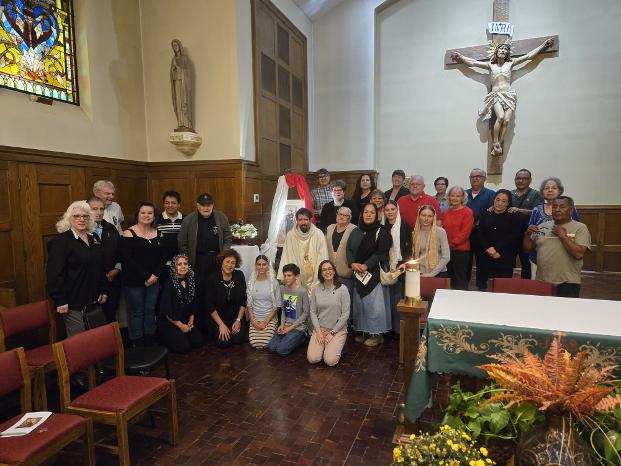

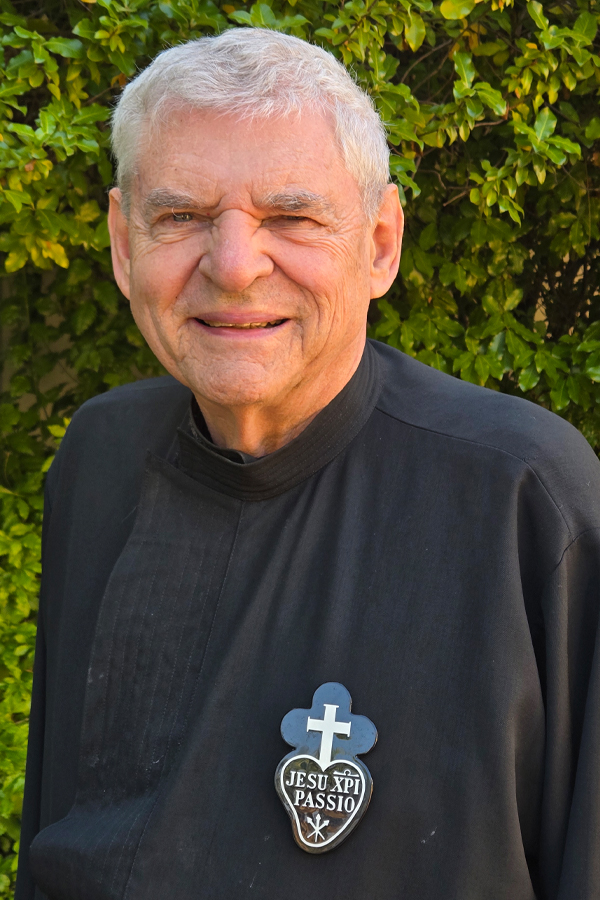
Every retreat at Christ the King Passionist Retreat Center in Citrus Heights, California, offers connection. As the retreat center’s director, Father Joe Moons, CP, and his dedicated staff create sacred spaces for encounters with God.
Passionist retreat Father Joe Moons, CP centers allow people to slow down, be heard, encounter God and experience compassionate presence. The power of presence happens not in big moments, but in small details.
“A lot of it is listening,” Father Joe explains.
“Presence is facing people and trying not to be in a hurry. We take in what they say, and it makes a big difference.”
Fr. Joe Moons, CP
The work of the staff affects each person visiting the retreat center. “All the staff is very attentive and welcoming,” says Father Joe.
“Presence is also about how we care for this place, from our housekeepers who create welcoming spaces indoors to our gardeners who care for the grounds outside.”
Since people come to a retreat for many different reasons, he believes the biggest reason is to get away from the noise of their lives. Whatever is challenging them — family issues or spiritual questions — the retreat center offers possibilities for peace.
“Retreatants, and others, look for reconciliation, recognition and forgiveness. They want some kind of direction or clarification. They want a different perspective, and a second opinion from what they have heard already,” shares Father Joe.
“I tell them to quit arguing with God.”
Fr. Joe Moons, CP
The retreat center is a sacred space in many ways: the physical place, prayer, hospitality and the people.
“All of these contribute to making it sacred,” explains Father Joe. “This place offers permission to focus on God in a meaningful way. You feel God’s presence. There is a sense of God’s peacefulness that allows one to share things. It is a safe place to be and to share. It takes a sacred place to share what one holds in one’s heart.”
Modern culture is filled with noise, technology and constant demands for our attention. The ministry of retreat and spiritual presence is a gift to those who come to Christ the King.
“The noise that is out there disconnects us from ourselves. There is maybe little interaction at meals as everybody is so busy about everything. We miss being present with one another,” shares Father Joe. “That is where life is. Because we live in a technological society, there are many distractions that keep us from being really present with one another. We can keep running, but we need to stop and listen.”
The connections made with retreat leaders and fellow retreatants can have a powerful effect, often helping people experience God’s presence in a new way.
“I think generally they feel it the first time,” says Father Joe. “We just operate at a certain level in life, and sometimes it is the inspiration of the other people at the retreat that helps individuals see what God wants for them.”
Many people who come for a retreat bring personal suffering and difficult questions. The Passionist charism embraces those challenges and offers a healing message.
“We are not afraid of the suffering. We can invite them to move beyond the struggles and see what God offers them, to see that they are not alone and that even in their struggles or brokenness, God is with them and does not leave them,” Father Joe explains.
God is all loving and merciful. He wants to nurture us. That is our real hospitality, the real openness.
Fr. Joe Moons, CP
Compassion changes everything and is the heart of the retreat center. The transformation happens not just with the retreatants, but also the staff, volunteers and Passionists who are part of the retreat center.
The staff and volunteers are a part of the Passionist Family and are present for each other in times of joy and sorrow. “That is all part of being compassionate. You take them all into your heart,” shares Father Joe.
Read more about Christ the King Passionist Retreat Center
Extended Video Interview
This transcript has been prepared for clarity, accessibility, searchability and readability, though minor variations from the original video may occur.
Taking Time to Listen
Question: When you hear the phrase “the power of presence,” what does it mean to you as a Passionist and retreat director?
Father Joe: Well, a lot of it depends on being present to people. It’s being available. I think it’s also being empathetic. I think the biggest thing is a willingness to take time to listen. The power of presence is a lot of listening, being there and available to listen. I think people take that in, and it makes a big difference to them: not being in a hurry, noticing someone, helping someone up the steps, opening a door for someone. Try never to be in a hurry. Another thing I’ve learned about presence is to face people when you’re talking to them, not turn your shoulder to them as if you’re ready to walk away. All these little things communicate a message that you’re there.
Question: So a lot of interpersonal communication techniques, it sounds like.
The Whole Retreat Center Is Present
Father Joe: Oh, yes. And it also depends on your staff. You’re dependent on the staff to be attentive and to respond to whatever it may be, because the retreat center’s presence is not just me. The presence is how the place is kept up: housekeeping, the gardens. Everything represents the presence of the Passionists here, in its own way, and the welcome.
What People Are Searching For
Question: People come to Christ the King carrying very different things: grief, questions, exhaustion, uncertainty, and some of them probably just need a place for quiet. What do you think people are searching for when they come through the doors of a retreat center today?
Father Joe: I think one of the things that touches them is basically getting away from the noise. We have oleanders along the drive as you come in for about 500 yards, so it’s like walking into a whole different venue. We’re in the middle of the city, but we have 29 acres now. Most of it is flood plain, though obviously the buildings are not. So that’s the bigger thing.
Then there’s work, certain family issues, and understanding God’s presence in life, which is a big issue: their relationship to God and their spiritual life. That’s another thing they want some kind of direction or clarification on. A lot of times their expectations are higher than what God expects. So I tell them to quit arguing with God.
Question: Yeah.
Father Joe: So that’s part of it. They’re looking for reconciliation, forgiveness, understanding, rest, peacefulness. With forgiveness, something happened in life, or is happening, and they want another way of looking at it. They just want a different perspective. And those who come back know what we’re like, so they think, “Well, the parish priest might have thought this,” and they just want a second opinion. [laughter]
Question: Yeah.
Father Joe: So that’s a lot of it.
What Makes a Retreat Center Sacred
Question: What would you say makes a retreat center a sacred space? Is it the physical location? The prayer, the hospitality, the people? Or is there something more than all of those things?
Father Joe: Well, I think all of them contribute to what makes it sacred. But certainly the men, for example, are not coming to watch a football game. They’re coming for a different reason, and they know that. That sets them up to enter a sacred space. They know they’re entering something different from a football game. Or for the women, it’s not a shopping spree. Whenever my two sisters get together, they go shopping. [laughter] So it’s that type of thing. It’s permission to focus on one’s relationship with God and others in a meaningful way, to talk about it, share about it, and listen to others.
The Retreat Within the Retreat
So many times we say there’s the retreat that we give as presenters, Passionists and lay people, but there’s also a retreat within the retreat, which is the men talking among themselves about issues they would not normally talk about while watching a football game, to put it very simply. The women are the same way, compared with when they’re shopping or talking about grandkids. It gives them permission, and they minister to one another through the stories they tell. It’s very beautiful. In fact, one retreatant mentioned, “The talks were very good, but what really helped me was listening to some of the other men on the retreat.”
So that part is very much sacred, because there’s a sense among everyone here that this place is holy and God is here in a special way. At least they’re more conscious of it. Hence it’s a safe place to be and a safe place to share certain things, whether with one of the Passionists, one of the lay staff, or some of the other men. When they’re talking at the table, it makes sense for them to say, “You said this about your wife and your child. I’ve had some of the same issues. What do you do about it?” That type of thing happens, and it’s not something you talk about in other places in your life. There’s really no place for that.
A Whole Weekend, Not a Few Minutes
Sometimes it’s sad. You go to Sunday Mass, you go to confession, and sometimes in the Sacrament of Reconciliation there’s an opportunity, but it’s short. You move into it and you move out of it. But this is a whole weekend. It can be an experience of sharing with other retreatants during the retreat, and the Sacrament of Reconciliation is sacred, as is just talking one-to-one with the lay Passionists on the preaching team. We have individual conferences outside of confession. There’s a sense of God’s peaceful, forgiving, and loving presence emerging in our interactions with everyone during this time at the center, which allows people to share things that normally don’t come up every day.
“You Are Only as Sick as Your Secrets”
There’s an expression that you are only as sick as your secrets. Sharing whatever one holds in one’s heart, and having it listened to, allows it to be healed and somewhat let go. That’s very important, and it takes a sacred place and a sacred time to do that.
Notes from Kairos Retreats
Question: Can you share an encounter you’ve experienced when simply listening or being present with a retreatant seemed to make a meaningful difference for that person?
Father Joe: I could share a lot. [laughter] A lot of people come back to me after about a year and say, “Father, what you said last time in confession, when we talked, really made a difference.” But I do want to share one in particular.
We have Kairos retreats, which are basically peer ministry: seniors giving retreats to seniors, and then of course you have the staff there, the adult faculty, campus ministry, and so on. I get a lot of good things from the Kairos retreats, let’s just say that. There’s one lovely note I got that had a big heart on the top. It was left in one of the bedrooms after the Kairos: “I just want to thank the staff and everybody for having this place here for us, because it really has changed me.” And then a little heart on the bottom.
Question: So it was a girl.
Father Joe: Yeah. [laughter]
Question: A guy would have gone right that way. Went for the heart, at least.
A Worried 14-Year-Old on a Confirmation Retreat
Father Joe: I get that a lot of times. It’s a beautiful retreat. But what I want to share with you is about one of our confirmation classes. We have confirmation days of recollection here for kids who are basically in ninth and tenth grade, so I guess about 13, 14, or 15 years old. This girl may have been 14.
During the confirmation class, she had done something else. She wasn’t supposed to receive her First Communion yet. This class had not received First Communion, so they were going to do it together with confirmation. But she went up and received, and she was all worried because she wasn’t supposed to. I don’t know exactly what happened.
We were at the front by the front door, so I went to the big room, set a couple of chairs down in the corner, and talked to her. She explained this to me, and she was so worried. I said, “It’s okay. You received Jesus. That’s a good thing. It’s a beautiful thing, and it’s your First Communion. That’s okay. It may have been a mistake, but it’s also a beautiful thing.” I prayed with her a little, then we talked a little more, and after that I asked, “Are you okay?” She said, “Yeah, okay.” So after about ten minutes, she went back to the group.
About eight or ten minutes later, I was talking to the speaker, and all the kids were on a break, just talking. She was free, so she came up to me and said, “Father, I want to tell you something. Thank you for talking to me, because it really made a difference.” When you get a 14-year-old saying something like that, it’s very touching.
Where Two or Three Are Gathered
It’s a beautiful thing. As a Passionist, and even among the speakers, the lay people, the lay Passionists, they have these encounters because this place creates the sacred space that allows this kind of sharing at this level. People are more involved. You feel God’s presence in those moments, in the midst of us. That expression where Jesus says, “Where two or three are gathered together, I am in the midst of them,” is certainly true in many of the things that make this place sacred. I think they’re aware of it, and I’m aware of it, and there’s a real vulnerability and humility in that type of relationship and in whatever is shared.
A Blessing That Goes Both Ways
Question: That has to be a blessing, because it isn’t just a connection from you and the staff giving the retreats to the people who are there for the retreats. It’s a back and forth. You’re in the servant position, caring for them, but to make that connection there has to be some back and forth, which has to be really powerful for you and the staff as well, feeling God’s presence.
Father Joe: Oh, yes. I shared that note I got with the staff, and they were very touched by it, because I had it with me. I’ll probably use it some more. It’s just a wonderful thing.
“Without Them You’re Nothing”
I’d say this: if someone is a grandmother, you presume there’s a grandchild somewhere. You can’t be a grandmother without a grandchild. The same thing is true of being a Passionist priest. There have to be people. People are part of your relationship to who you are. You’re not ordained for yourself as a Passionist priest.
Question: Yeah.
Father Joe: You’re ordained for the people. As Cardinal Newman told the bishops and the cardinals when he gave a retreat, “Be nice to the people, because without them you’re nothing.” [laughter]
Question: Well, it’s a beautiful thought.
Father Joe: It’s our relationship to them, and theirs to us, that blesses us and consecrates us in our own vocations. And we forget that connection sometimes. It’s easy, I think, to forget it or be distracted.
Question: Who said that quote, Father Joe? “Be nice to the people; without them you are nothing.”
Father Joe: Cardinal Henry Newman.
Question: Oh, okay.
Father Joe: He was an Episcopal scholar at Cambridge, and Dominic Barberi brought him into the Catholic Church. St. Dominic Barberi is a Passionist saint.
Question: Yeah.
Father Joe: His work is very powerful. I enjoy his writings very much.
Retreat in a Culture of Noise
Question: We live in a culture with a lot of noise, technology, and constant demands on our attention. Do you think the ministry of retreat and spiritual presence has become more important today because of all those things? And if so, why?
Father Joe: Oh, I think it has, for the very reason I gave earlier. All of that out there works against our need for a spiritual life. It disconnects us from ourselves. It distracts us from the things that are meaningful. We play with our phones while we eat, and sometimes there’s no interaction between the siblings and the parents, or with the grandkids. It’s not just young people; it’s everybody. Everybody gets so busy with everything, and we miss the point of being with one another, being present to one another. And that’s where life is: to laugh, to listen, to share difficulties, to share good things. A meaningful understanding of myself and others, of relationships, and of who God is in my life. These things are not planted or nurtured in our lives. We’re distracted from them by a very hedonistic, very technological society. There are so many distractions out there, and we can keep running.
Question: Yeah.
Father Joe: Instead of stopping when we need to stop and listen.
“I Should Have Come 22 Years Ago”
Question: When people come to the retreat center for the first time, do you sense a powerful response right away, or is it something more gradual? Maybe they buy into it a bit the first time, but then they have to come back to fully feel it. What do you think?
Father Joe: I think generally they feel it the first time. We have captains, or what we call coordinators, in each parish. One coordinator had been asking a man for 22 years to come. So finally, to get him off his back, he came on the retreat. I asked him, “So what was the retreat like?” He said, “Well, I’ve got to tell you, Father, I should have come 22 years ago. [laughter] I’ll be back next year, and I want to thank [the coordinator] for asking me and pushing me.”
That’s the reality. I think the younger men and women especially need it, but they can’t come because of the kids. They can’t get away.
Forty Phone Calls
It’s interesting, though. One young mother came on a retreat and said, “I told my husband, ‘You take care of the kids. I do it every day. You can do it for one weekend.'” [laughter] She got 40 calls, but she got there.
Question: That’s great. It seems like people might not be expecting it, like the gentleman who’d been invited for 22 years. He may have thought, “It’ll be all right,” and then he got there, and that sense of space and the people really were powerful and lifted him up.
Beyond McDonald’s
Father Joe: Yeah. Well, it’s like going to McDonald’s every day, when that’s the only thing you know. They’re pretty good hamburgers. The fries are pretty good. A couple of the other things they make, like the ice cream, are pretty good. But then you go to a very nice restaurant, and you think, “Oh, there’s other food besides McDonald’s.” [laughter]
You’ve been living on McDonald’s all your life, at a level where you’re not in touch with yourself or with your relationship to your wife, or your husband, or your kids. You just operate at a certain level. And then you realize there are other ways of working on this, and sometimes it’s the inspiration of the other men or women on the retreat that gives you the idea that this is possible.
Question: Yeah.
Father Joe: That it’s what God wants for you.
Not Afraid of Suffering
Question: How does the Passionist charism shape the hospitality and ministry people experience at Christ the King, especially those who come with suffering or difficult questions?
Father Joe: Well, basically, we’re not afraid of the suffering and struggles of others. We can often invite them to move beyond those things as much as possible, by welcoming the retreatants and always seeking to move them beyond their struggles somehow, to see what God desires for them. Not to look at their shortcomings, brokenness, and loneliness, but to see that they’re not alone, and to know that even in their brokenness or struggles, God is there with them. He doesn’t leave them. That’s part of it.
A God Who Doesn’t Need Your Help
What’s happening in their lives matters to God, who is all loving and all merciful. He’s not there to judge. He’s not there to count the things that are wrong. He has every desire to nurture you as much as He can, so you can love yourself and love those around you. That’s all He worries about. That’s what His grace is all about. With anything, the sinfulness, the brokenness, the hurt, He just hopes that you go beyond it and let go of it. I often say He’s not there to punish you or to make you feel guilty, because you pretty much do that yourself. He doesn’t need your help.
But that’s the real heart of it, that openness.
Hospitality in Every Detail
Besides what I mentioned earlier, everything contributes to hospitality: the gardens, the clean bedrooms, the food. To me, food is extremely important, especially desserts.
Question: Yes. [laughter] It’s the main part of every meal. You’ve got that right.
Father Joe: No, but seriously, it all contributes: the cleanliness of the house, the chapel, the liturgies, how things are celebrated, how much we welcome people into the liturgy. It’s not an individual act. Liturgy is a community action.
Compassion Among Staff, Volunteers, and Community
Question: If compassion changes everything, where do you see that transformation happening at the retreat center, not only among retreatants, but among staff, volunteers, Passionists, and the wider community?
Father Joe: As retreat center director, I interact with the staff in many different ways, particularly by listening to them and being there. It’s in the way we run the retreat center and the way we are present to the different needs of the retreat as they’re met by the different staff members, and in being attentive to things that may be affecting them, including their families. That includes volunteers, the local community, and at times the wider community: presiding at a funeral, visiting those who are sick or in hospice care, and praying with them when appropriate.
Anointing a Beloved Volunteer
On Friday, one of our main volunteers, who is just a lovely woman, the type of woman who, when she’s in a room, it’s as if a bright light comes on, was in hospice care. She has dealt with cancer for five years. So Sandra, our event manager, and I went over to the house, and we anointed her. We spent about an hour and 20 minutes there with her family, her husband and two of her children, who are grown and married. That’s all part of being compassionate: taking people into your heart and seeing what can be done, what needs to be done, when it needs to be done. It has become very important.
Compassion Goes Both Ways
Question: And I’m sure it’s a mutual thing, everybody doing it for each other.
Father Joe: Oh, yes.
Question: It’s a good thing, like you’re feeding each other: you need this, and I can give it to you now, and later I’m going to need something, and you’ll give it to me then.
Father Joe: Well, it’s interesting. Father Jim, our superior, Jim Strommer, had a stroke, and the number of get-well cards he gets, and the people asking me how he’s doing, is all part of the compassion, which goes both ways. Like you said, it’s not just us going out, but also them coming to us.
Question: It’s very, very powerful.
Gratitude: The Root of a Vocation
Question: Reflecting on all of this, is there anything that popped into your head that I didn’t ask you about?
Father Joe: One thing I would share, and maybe I should have put it at the beginning, is why I became a Passionist. I think the greatest sense in my life has always been a sense of gratitude. Even as a child, there was a line in the psalm we said: “What can you give in return for all that God has given you?” I’ve always had that sense, and I’ve always wanted people to be grateful for what God can do in their lives. I don’t know whether it’s a tender thing for me or just that sense of gratitude, but it has always been there.