El padre Michael Ogweno, C.P., vive en un pequeño pueblo llamado Jwaneng, a unos doscientos kilómetros de Gaborone, la capital de Botsuana. Es el párroco de la iglesia católica Lapa La Lorato (Familia del Amor) en Jwaneng, que también atiende a las aldeas vecinas.
Su ministerio acompaña a católicos que carecen de agua potable y de suficiente alimento, pero que están llenos de esperanza, una esperanza visible en su vida diaria. Nunca dejan de reunirse cada domingo para orar y dar gracias a Dios por sus vidas.
“De donde yo vengo, creemos activamente en la esperanza”, comparte el padre Michael. “Hay tanto que anhelamos y aún no hemos alcanzado. Pero hay que representar en si mismo el cambio que uno desea ver. Mañana seremos mejores que hoy.”
“Con Dios, cada día es una nueva oportunidad para comenzar de nuevo.”
Fr. Michael Ogweno, CP
Los miembros de la parroquia Lapa La Lorato (Familia del Amor) conocen bien el poder de la esperanza. Después de perder a su primer párroco, estos fieles católicos esperaron y rezaron continuamente para que Dios les enviara un nuevo pastor.
Entonces le pidieron al padre Michael que fuera a Jwaneng a ayudar. Dios les concedió una comunidad llena de alegría. “La gente había estado privada de mucho durante años, pero en su interior algo les decía que algo bueno iba a pasar, y así fue”, explica el padre Michael. “Aunque la parroquia estaba deteriorada y todo en ruinas, la gente seguía ahí. Cuando me pidieron que fuera, dije: ‘Aquí estoy’. No fue fácil, porque yo estaba en un lugar donde todo marchaba bien. Ir a Jwaneng significaba empezar desde cero. Pero luego pensé: si no voy yo, ¿quién irá?”
A través de los sacramentos, el padre Michael ofrece esperanza y fortaleza a sus feligreses. Y en la fe y confianza de ellos, su propia esperanza se renueva.
“Con Dios, cada día es una nueva oportunidad para comenzar de nuevo”, dice el padre Michael. “He visto eso incluso cuando visito a personas que viven en situaciones realmente difíciles. Luego veo sonrisas en sus rostros. Yo llego como sacerdote y administro los sacramentos. Los sacramentos son un acompañamiento poderoso que la gente celebra porque saben que Dios es presente en sus vidas. Ahí se ve la fe del pueblo. Una fe viva, real.”
La vida sencilla de esta comunidad ayuda a mantener a Dios en el centro de todo. Ellos saben que Jesús comprende el dolor y el sufrimiento que experimentan.
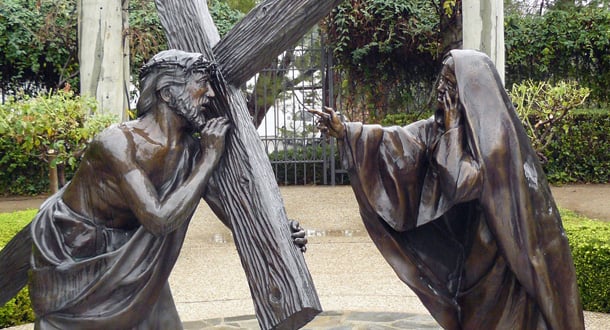
“Yo solo comparto la Palabra de Dios. En la historia de los pueblos, nadie ha pasado por un infierno como el Hijo único de Dios”, comenta el padre Michael. “Él lo hizo para darnos ejemplo y para fortalecernos a hacer lo mismo. Estamos llamados a seguirlo, cargando nuestras cruces cada día. Creo firmemente que Dios tiene algo que decirnos en todas nuestras experiencias humanas. Si tan solo prestáramos un poco de atención, podríamos descubrir cómo quiere Dios que respondamos ante cada situación.”
La vida del padre Michael cambió al llegar a Jwaneng.
“Lo que más me sorprendió fue a mí mismo”, explica. “Cuando llegué, dije: esto se puede hacer, la vida puede continuar. Mi parroquia anterior estaba en la ciudad y todo era más fácil. Ahora, cuando necesito algo, tengo que pensarlo dos veces, ver si realmente lo necesito, y establecer prioridades.”

Lo que más lo ha ayudado a sobrellevar las dificultades son las personas de su comunidad y su capacidad para valorar los dones que tienen.
“La gente tiene diferentes experiencias y distintas expectativas”, dice el padre Michael. “Aprecian tener un sacerdote que celebre la Eucaristía con ellos. Y, en lo personal, me he dado cuenta de que cuando uno está en un lugar cómodo, da las cosas por sentadas. Pero cuando se carece de comodidades, uno aprende a ser más agradecido con Dios por todo lo que recibe.”
“El bien que sucede no aparece en las noticias…Dios sigue con nosotros, a pesar de todo lo que pasa a nuestro alrededor.”
P. Michael Ogweno, CP

El padre Michael está convencido de que, aunque el mundo parezca lleno de negatividad y maldad, debemos abrir los ojos al bien y seguir esperando.
“El bien que sucede no aparece en las noticias. Pero creo que la presencia de Dios hace que la gente despierte y crea que puede haber algo mejor”, comparte el padre Michael. “Eso también ha alimentado mi propia esperanza. Tal vez necesitamos sintonizarnos más con lo que Dios está diciendo y haciendo. No será noticia, pero ahí está Dios. Dios sigue con nosotros, a pesar de todo lo que pasa a nuestro alrededor.”
La entera entrevista en inglés
Question: Do you see hope as an active state, a prayerful one, or both? Is it more meditative? Is it a call to action?
Father Michael: For me, it is both. When we talk about hope, especially where I come from, we actively live in it. There is so much we look forward to that we have not yet achieved, and we know that to reach our goals, we must get involved. As the saying goes, you must be the change you want to see. Hope is not passive—it calls us to act and make life better.
Why We Need Hope
We all need hope because, no matter our situation, there is always something we long for. Each of us needs something different, but we all share the desire for tomorrow to be better than today.
Restoring Hope in the Parish
My parish had been closed for a time, and when I returned, I found that people had not completely given up. Some left, but many stayed, still gathering and praying together. Their persistence reminded me that with God, each day is a new beginning. Hope allows people to say, “Let us keep going; tomorrow something will happen.”
As a priest, I nurture hope by sharing the Word of God. I believe God has something to say in every human experience. If we listen carefully, we will discover how He calls us to respond. The sacraments, too, are a powerful sign of God’s presence. They bring strength and peace, no matter the circumstances.
Returning to a Closed Parish
When I was asked to return to this parish, it was not an easy decision. I had been in a comfortable place where things were going well. Moving felt like starting over. I wondered, “Why me?” But then I reminded myself—if not me, then who?
I found encouragement in Scripture. None of God’s people were ever given an easy task. Even Jesus endured suffering. He said, “If anyone wants to come after me, let them deny themselves, take up their cross daily, and follow me.” Hope requires perseverance.
Discovering Joy in Simplicity
At first, I felt like I was being sent to a difficult place. Yet through prayer, I found peace. I realized I could live simply and be content. I used to rely on conveniences like television or nearby shops, but now I think twice about what I truly need. This experience has taught me gratitude—for life, for faith, and for the people around me.
The community is deeply appreciative. They cherish the Eucharist in ways many of us take for granted. Even without much, their joy and faith are vibrant. Seeing that has changed me.
Challenges and Gratitude
Life here has its challenges. The water is undrinkable, and many cannot afford clean water. My bishop gives me the equivalent of $400 a month, which must cover everything—water, food, petrol, and clothing. Still, I am grateful. I have learned to be frugal and to stretch what I have, and that simplicity brings peace.
Hope from the People
Two catechists volunteer alongside me—one older woman and one younger. They receive nothing in return, yet their dedication is unwavering. Their faithfulness and joy inspire me. When I visit parishioners, even those in mourning or deep poverty, their smiles encourage me. Often, I feel I have little to give but my presence, and yet they are profoundly grateful for that. It reminds me that walking beside others—ensuring no one walks alone—is one of the greatest acts of hope.
Staying Hopeful Amid Chaos and Poverty
It is easy to feel overwhelmed by negativity in the news, but I believe goodness still fills the world—it simply does not make headlines. Even in poverty, people smile and live with joy. That must be the presence of God. God’s quiet work may not make the news, but it is real and visible in everyday acts of kindness and endurance.
Being a Pilgrim of Hope
You do not need to go to Rome to be a pilgrim of hope. A pilgrimage is more than a journey to a holy place—it is an inner transformation. Hope begins as a shift within the heart: moving from despair to faith, from darkness to light. Some people have everything yet still feel hopeless, while others with very little live with joy. Hope is a spiritual, mental, and emotional journey we all must make.
The Supplies for the Journey
To be pilgrims of hope, we need three things: faith, trust, and charity.
Faith in a higher power, trust that God has our best interests at heart, and charity toward others—sharing not only material goods but also our time, our compassion, and our willingness to listen. True charity is about connection.
We must care for others as we care for ourselves. When we lift others, we ourselves are lifted. Joy comes from love, not possessions.
God’s Lessons in Loss and Trust
I have known deep loss. My father died in 1981 and my mother in 1994. Their deaths shook my faith so deeply that I nearly left the priesthood. I was angry with God. I took time away and lived alone, praying and reflecting. During that solitude, I realized that God does not change His mind—when He calls, He provides what we need to continue.
Those trials taught me to trust that God leads even when the path is uncertain. Like the Israelites at the Red Sea, I hear a voice saying, “Keep marching on.” I have faced many challenges since, but God always provides. Through kind people and unexpected help, He reminds me that He is with us until the end.