In these days following the attack on Iran by Israel and the United States, our hearts are heavy.
Images of destruction, fear, and uncertainty once again remind us how fragile our world is, and how quickly violence can be justified as necessity. We hold in prayer all who are suffering — innocent civilians, families living in fear, those grieving loss, and all who now face an uncertain future.
Let us be clear: to question war is not to excuse tyranny. The Iranian people have long endured repression, restriction of freedoms, and political oppression. Their suffering is real. The Church does not close its eyes to injustice wherever and however it occurs. Human dignity is violated by authoritarianism and by violence alike.
To stand for peace is not to romanticize regimes; it is to insist that the cure must not deepen the wound.
We are living in a time marked by so many isolated Egos, Nations assert themselves. Leaders defend interests. Groups cling to identity. Each claims justification. Beneath these visible tensions lie powerful international and multinational financial forces: a global arms trade that thrives on instability, energy markets that shift with every escalation, reconstruction industries poised to profit from devastation, and complex networks of investment that quietly calculate risk and gain.
What Pope Francis has called an “economy that kills” can take shape when profit becomes detached from moral responsibility. The modern military-industrial complex — deeply embedded in national economies — can make perpetual preparedness for war seem normal, even necessary.
In such a climate, decisions about conflict are never purely political; they are entangled with systems that benefit from fear and insecurity. And so, instead of working together for the common good, we so often find ourselves divided, suspicious, and ready to strike. War is presented as the path to security; weapons multiply; vast resources are poured into instruments of destruction, while poverty, displacement, and injustice deepen. The logic of power — and profit — overshadows the harder, holier work of dialogue.
As we walk through this Lenten Season, our eyes are fixed not on triumph, but on the Passion of Christ — a journey marked not by domination but by radical vulnerability, mercy, and compassion.
On the night before his arrest, Jesus addressed even Judas as “friend” (cf. Luke 22:48), refusing to abandon him to hatred. When Peter drew a sword and struck at another’s life, Jesus commanded him to put it away (Matthew 26:52), and he looked upon him with compassion (cf. Luke 22:50-51). On the cross, there was no cry for retaliation. Instead, Jesus prayed for forgiveness for all: “Father, forgive them; for they know not what they do” (Luke 23:34).
This is the face of God revealed in Christ: one who does not give in to the temptation of reversing the curse upon the world, yet who opens up mercy for all.
If we are true disciples of Christ — and if some of our leaders proclaim themselves Christians — how can we use language that echoes threat and triumphalism rather than reconciliation and restraint?
In public statements in the days following these military actions, senior United States defense leadership has affirmed a mission of decisive and overwhelming force, at times using language that bluntly warns adversaries, “we will kill you.” Such rhetoric may aim to project strength, but it stands in sharp tension with the Gospel we proclaim.
The language of annihilation and absolute destruction does not resemble the language of the crucified Lord.
Language of threat and rhetoric of “winning” a conflict cannot truly embody the Gospel of Christ, who teaches that love of enemies and turning the other cheek are not optional moral ideals but radical ways of life. Even if war is judged to be a last resort in international affairs, it cannot be cheered as triumph. It cannot become a spectacle to be justified with slogans or faith-infused rhetoric that bypasses the hard work of peace.
The ease with which leaders invoke force, or frame conflict in absolutist terms, risks normalizing violence and diminishing the seriousness of Christian witness in a world longing for peace.
As Pope Leo XIV said after the Angelus yesterday, “Stability and peace are not built with reciprocal threats nor with weapons that sow destruction, pain, and death, but only through a reasonable, authentic, responsible dialogue.”
But the Gospel challenge does not rest only with political leaders. It rests first with us.
Jesus does not seek perfect people, much less self-righteous teachers. He calls disciples — ordinary women and men, different from one another, who agree to bear witness to his way of non-violence, mercy, and reconciliation.
And what is his word to us as we behold his Passion? Not accusation. Not derision. Not the triumph of force. But steadfast love and the call to forgive and to love without excluding anyone.
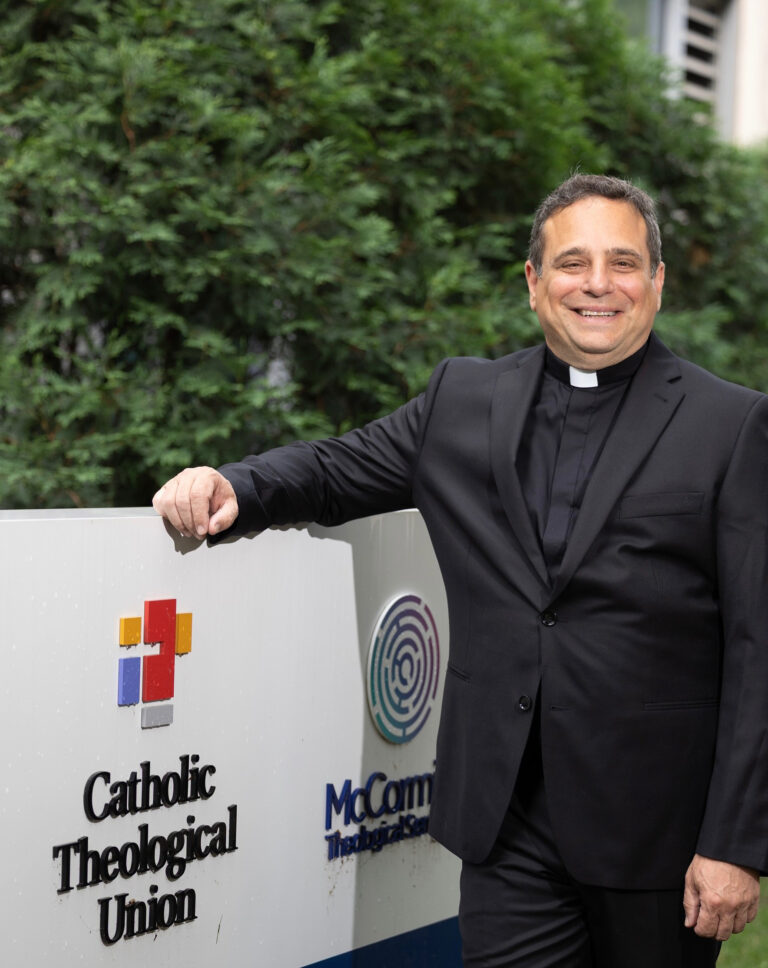
As President of Catholic Theological Union, I call our community — and all people of faith — to resist the seduction of inevitability. Violence is not destiny. We must form leaders who believe that dialogue is stronger than domination, that encounter is braver than enmity, and that human dignity transcends borders and political alliances.
We pray for leaders everywhere — that they may choose restraint over escalation and negotiation over destruction. We pray for scholars, ministers, and students preparing for service in a wounded world, that they may become artisans of peace. And we pray for ourselves, that we not retreat into indifference or cold analysis, but allow our hearts to be converted.
May the God who endured suffering out of love for all break through our fear and hardened certainties.
May his peace conquer coldness, indifference, and violence.
May he teach us that we are truly happy when we care for one another, without excluding anyone.
In this Lenten faith, even amid conflict and uncertainty, we commit ourselves anew to the work of reconciliation.
Peace be with you.