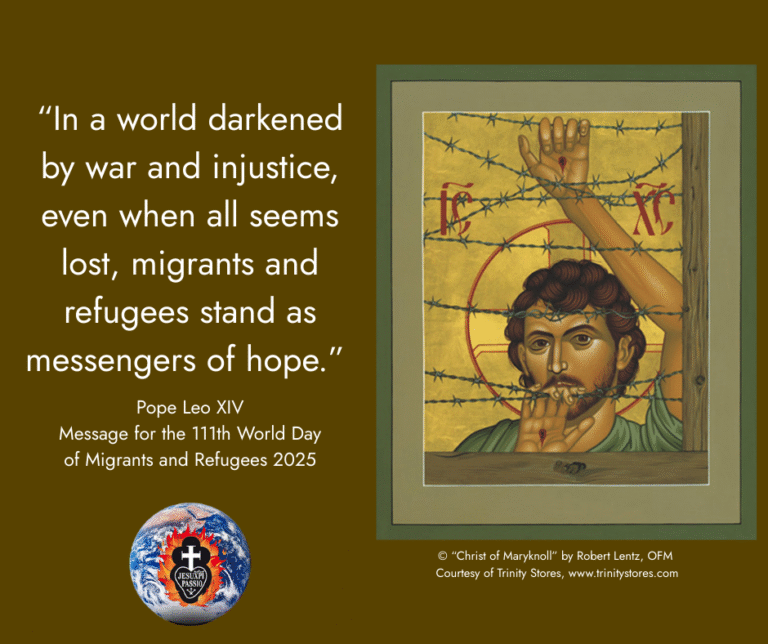
They crucified Him again last Tuesday.
Not on Golgotha this time
at a bus station in Texas,
in a detention center in Louisiana,
in a van with tinted windows
that drove a father away from his children
while they screamed his name
into a sky that did not answer.
And somewhere,
an angel who once rolled back a stone
looked at Heaven and whispered:
Again?
And we
we who wear crosses around our necks,
we who sing “Whatsoever you do
to the least of my brothers”
we turned up the volume on our worship music
so we wouldn’t hear the screaming.
Tell me,
when did the Body of Christ
become something we only consume on Sundays
and refuse to recognize on Mondays?
When did “I was a stranger
and you welcomed me”
become a verse we skip
on the way to something
more comfortable?
He is five years old.
He doesn’t know the word “deportation.”
He only knows that his mother
was there at breakfast
and gone by dinner,
and no one can explain to him
in any language on this earth
why the world just did what it did.
He will carry this wound
longer than he will carry her face in his memory.
One day he will forget
the sound of her voice.
But his body will remember the scream.
His body will always remember the scream.
And somewhere in heaven,
Mary, who once fled to Egypt
with an infant in her arms,
a refugee, running from a government
that wanted her child dead
Mary is weeping again.
She knows this story.
She has always known this story.
We say, “Lord, when did we see you hungry?”
And He answers from a cage.
We say, “Lord, when did we see you a stranger?”
And He answers from a courtroom
where no translator was provided.
We say, “Lord, when did we see you naked?”
And He answers from a cell
where they took his shoelaces and his rosary
and called them security risks.
We say, “Lord, when did we see you sick?”
And He answers from a floor
where a woman labored alone
because the detention center
does not have a word for mercy
in its operating manual.
We say, “Lord, when did we see you?”
And He says:
You didn’t.
That was the problem.
You looked right at Me
and you saw a problem to be solved,
a number to be processed,
an alien, you called Me an alien
in the country I created.
Do not tell me your faith is strong
if it cannot hold the weight
of a migrant mother’s tears.
Do not tell me you love Jesus
if you cannot see His face
in the undocumented worker
whose hands picked the fruit
you blessed before you ate it.
Do not tell me the Church is alive
if the Church is silent
while the nails are still being driven.
Calvary was not a tragedy
because wicked men crucified an innocent one.
Calvary was a tragedy
because ordinary people watched.
The soldiers were following orders.
The crowd was just curious.
The Pharisees were protecting tradition.
The disciples were “processing their feelings.”
And Peter
Peter was warming himself by the fire
of the empire that was killing his Lord,
because the night was cold
and the fire was convenient
and nobody was asking him
any questions yet.
We have not run out of Peters.
We have not run out of fires.
We have not run out of ways
to say “I do not know that man”
while His blood is still on our hands.
Romero said:
“A church that does not provoke crisis,
a gospel that does not disturb
what kind of gospel is that?”
I will tell you what kind.
The kind that fills stadiums.
The kind that sells books.
The kind that makes everyone feel
warm and blessed and chosen
while the crosses are being erected
just outside the parking lot.
I do not want a Church
that only weeps at the Stations of the Cross
on Good Friday
and then builds walls
on Easter Monday.
I do not want a Church
that kneels before the Crucifix
and genuflects before the empire
in the same hour.
I want a Church that bleeds.
I want a Church that sees a family torn apart
and does not ask for their papers
before it offers its prayers.
I want a Church that remembers,
remembers in its bones
that our God did not check immigration status
before He died for the whole world.
I want a Church worthy
of the Crucified.
So here is my lament:
Not that the world is cruel
I expected that.
The empire has always been cruel.
Pharaoh was cruel.
Herod was cruel.
Pilate washed his hands
and thought that made them clean.
My lament is this:
That we, the baptized,
the confirmed,
the ordained,
the consecrated
we looked at the crucifixion happening
in our own neighborhoods
and called it policy.
We called it border security.
We called it not our problem.
We called it legal.
As if the cross was ever legal.
As if “legal” ever meant right.
As if the tomb wasn’t a government-approved solution
to the problem of a man
who loved too many of the wrong people.
And Christ bled anyway.
Christ always bleeds anyway.
The question was never
whether He would suffer for them.
The question was always
whether we would suffer with them.
That is the only question
the Passion has ever asked.
The body is still warm.
The tomb is not yet sealed.
There is still time
to stop standing at a distance
and start climbing the hill.
But you will get blood on your hands.
You will.
The wood will give you splinters.
The road will wreck your knees.
The crowd will call you foolish.
The empire will take down your name.
But halfway up that hill,
through the dust and the noise
and the unbearable weight of it all,
you will see His face.
And He will see yours.
And for the first time,
you will understand
why the saints wept
every time they spoke of the Passion
not because it happened then,
but because it is happening now.
And the only thing worse
than a crucifixion
is a crucifixion
that no one bothered to attend.
Show up.
The body is still warm.
That’s how you know
you’re finally close enough.
A Passionist Lament
Johnson C.P
The Passion of Jesus continues in this world. It will continue until the end of time.
St. Paul of the Cross
We are called to keep alive the memory of the Passion – to stand with the crucified of today.
Passionist Constitutions
The Passion of Jesus is the greatest and most overwhelming work of God’s love.
St. Paul of the Cross