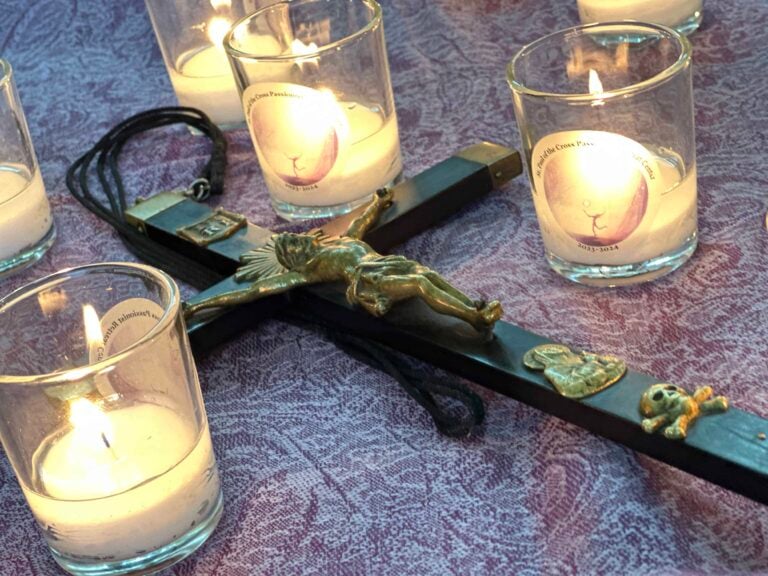
For Passionists, our engagement with the world is rooted in the memory of the Passion of Jesus. Our charism calls us to recognize the suffering of Christ in the suffering of people and creation today, and to respond with compassion, solidarity and hope.
These reflections are offered not to endorse or oppose any candidate or political party, but as an invitation to consider how the Passionist charism can help form our consciences as we participate in civic life.
The Passionist charism does not provide a simple checklist for the voting booth. Instead, it invites us to pay attention: to the dignity of every person, to our neighbors, to the wounds of creation, to divisions within our communities and to those whose suffering might otherwise go unnoticed.
As we prepare to vote, we invite you to reflect with us.
Begin at the Foot of the Cross
The Cross is at the heart of Passionist spirituality. It reminds us that God is not distant from human suffering. In Jesus crucified, God enters fully into the pain, injustice, fear and vulnerability of the human experience.
Standing at the foot of the Cross asks something of us, too. We cannot look upon the suffering of Christ while remaining indifferent to suffering around us.
As we prepare to participate in civic life, we might begin not with arguments or political labels, but with attention. Where do we see suffering in our communities? Whose experiences have we taken the time to understand? Whose suffering have we overlooked?
Our responsibility begins with seeing.
For reflection:
What suffering in our world am I being invited to notice more deeply?
Remember the Dignity of Every Person
The Passion reminds us of the immeasurable value of every human life.
Jesus encountered people who were sick, grieving, poor, rejected, misunderstood and pushed to the margins. Again and again, he restored people to relationship and reminded them that they were seen and loved.
That same recognition of human dignity should shape the way we encounter one another today.
In a time when it can be easy to reduce people to political identities, disagreements or categories, our faith asks us to see something deeper: a human person, created and loved by God.
This includes people whose lives and experiences are very different from our own.
For reflection:
How am I being called to recognize and protect the dignity of people whose experiences I may not fully understand?
Ask, “Who Is My Neighbor?”
The Passionist charism draws us beyond ourselves.
Our choices are rarely ours alone. They affect families, neighborhoods, communities and people we may never meet. Christian discipleship continually widens the circle of those we are willing to call neighbor.
Solidarity asks us to consider not only our own needs, but the well-being of others. It invites us to listen to experiences beyond our own and to recognize that the struggles of another person are not entirely separate from us.
As we discern our responsibilities as citizens, the question “Who is my neighbor?” can challenge us to think beyond individual interests and toward the common good.
For reflection:
Who do I naturally consider my neighbor, and who might God be asking me to include in that circle?
Listen Before We Speak
We live in a time of deep division. Political conversations can quickly become arguments, and disagreement can make it tempting to dismiss another person before truly hearing them.
The Passionist tradition offers another way.
To stand beside someone who suffers is often to listen before trying to answer. Accompaniment requires humility, patience and the willingness to encounter another person’s experience without immediately making it our own.
That same spirit can shape our civic life.
Listening does not require us to abandon our convictions. It asks us to remember that the person across from us is more than an opinion, a political label or a vote.
Our communities need people capable of disagreement without contempt and conviction without losing compassion.
For reflection:
When I encounter someone with whom I disagree, do I listen in order to understand, or only in order to respond?
Hear the Cry of the Earth
The Passionist commitment to those who suffer extends to our relationship with creation.
The wounds of our common home are closely connected to the lives of people. The quality of the air we breathe, the water we drink, the land that sustains us and the climate we share affect communities today and generations still to come.
Care for creation therefore cannot be separated from care for one another.
Our responsibility is not simply to admire creation, but to recognize it as a gift entrusted to our care. The choices we make individually and collectively help shape what we leave for those who come after us.
As Passionists, we are invited to recognize the wounds of creation and respond not with despair, but with responsibility and hope.
For reflection:
How do my choices reflect care for creation, for my neighbors and for generations yet to come?
Seek Peace in a Divided World
Peace is more than the absence of conflict.
True peace requires justice, reconciliation, truth and a willingness to see one another as members of the same human family.
That can feel particularly difficult during an election season. Political disagreement can divide families, communities and even faith communities. Yet our call to peace does not disappear when disagreement becomes difficult.
The Cross reminds us that violence and hatred do not have the final word. As people shaped by the Passion, we are called to resist the temptation to dehumanize one another and instead become witnesses to another way of living together.
That work begins in our own conversations, relationships and communities.
For reflection:
Do my words and actions contribute to greater peace, understanding and reconciliation?
Carry the Charism With You
There may never be a perfect choice or a simple answer waiting for us in the voting booth.
Discernment asks more of us.
It asks us to pray. To learn. To listen. To examine our consciences. To seek reliable information. To consider experiences beyond our own. And, above all, to remember those who suffer.
For Passionists, the memory of the Passion is not something reserved for churches, retreats or prayer. It shapes how we encounter the world.
As we participate in civic life, may we carry that memory with us.
May we notice those who are suffering.
May we recognize the dignity of every person.
May we care for our common home.
May we seek peace rather than deepen division.
May we listen with humility.
And may our choices be rooted in compassion, solidarity and hope.
For reflection:
What would it mean for me to carry the memory of the Passion with me into the voting booth?