

As we prepare for the celebration of the birth of Christ, the Church has given us some deeply inspirational liturgical readings.
I was particularly caught this year by the words and the history articulated by Isaiah of Jerusalem (First Isaiah). Listening to him, I realize he really has something to say to us.
We need to ask ourselves at a deeper level, “Who is this messiah?”
Isaiah develops some foundational texts which still guide us 2,700 years later. It would be a mistake to gloss over these.
Living eight centuries before the birth of Jesus, Isaiah starts imaging the elements of what the Messiah of God will be. The impetus for this comes from the political and religious situation of the day as Assyria persistently expanded and conquered lands. Imagine that being the daily news!
Recall how the nation of the Hebrew people was already divided by this time with Israel in the north and tiny Judah in the south. Ahaz, King of Judah, refuses to join the anti-Assyrian coalition. Instead, he chooses to align himself with the more powerful nation. The daily news illustrates how Judah faces the reality of this advancing army, and many of the people do not trust their king. Certainly, our contemporary stories of countries at war, speculations of alliances, peace talks that fall through, gift us with a view of the fragility of Isaiah’s situation.
Every year as we prepare for Christmas, we listen to these familiar stories, frequently neglecting the chaos from which these texts originated. The Messiah’s origins, formed in crisis and waiting, invite careful listening, not casual hearing.
Reading deeply into the full text of this prophet reveals that Isaiah of Jerusalem is concerned, involved, critical, outspoken and passionate. Looking into the future, he is worried. Here is the thing. He has more faith in God than he does in humanity. He knows that there can be no redemption which originates from human achievement or human will. Humanity has failed. Even the monarchy has collapsed. Consequently, Isaiah begins the foundations of Messianic hope.
Isaiah 7
Isaiah had begged Ahaz the King, trust the God of Israel. Do not trust a corrupt king. He even went so far as to tell Ahaz to ask God for a sign that showed God was on our side. And we all know Ahaz’s response. “I will not ask, I will not tempt the Lord!”
It was not that Ahaz was pious, regretfully, he acted out of cowardness. We frequently leave out of the story that Ahaz actually made a deal with Tiglath-pileser III, King of Assyria, emptying the silver and gold from the temple treasury for his help. Out of the chaos of the Assyrian crises comes this pronouncement, “Therefore the Lord himself will give you a sign; the young woman, pregnant and about to bear a son, shall name him Emmanuel.”
Isaiah 9
Two chapters later, Isaiah writes, “The people who walked in darkness have seen a great light; Upon those who lived in a land of gloom a light has shone… For a child is born to us, a son is given to us; upon his shoulder dominion rests.”
This oracle is proclaimed during war, not after it. Remember, Assyria is advancing, Northern Israel is under imminent threat and will soon fall. Judah is politically compromised. Isaiah’s prophecy contradicts visible reality. Even if Isaiah first spoke to his own moment in history, the hope he announces was larger than any king who ever lived. In a bold way, Isaiah implies that hope begins where loss has been greatest.
Think of the images we have seen from Gaza. Or, imagine if your home was Ukraine. How would you respond to a man proclaiming this message living in that fear and chaos?
Isaiah speaks of a child who in that culture was symbolized by dependence, fragility, and vulnerability. Children were for a nation’s future, not their present entanglement. This child will not grow into earthly power utilizing force and dominance.
Instead, this child will teach us a new authority. Isaiah is asserting that violence does not get the final word, even when it appears to be winning. The exile will later reveal truths about God’s redemption: God does not start with the large countries and bring them into power. Redemption has its footings in defeat not in triumph.
Isaiah 11
“But a shoot shall sprout from the stump of Jesse, and from his roots a bud shall blossom. The spirit of the LORD shall rest upon him: a spirit of wisdom and of understanding, A spirit of counsel and of strength, a spirit of knowledge and of fear of the LORD, and his delight shall be the fear of the LORD. Not by appearance shall he judge, nor by hearsay shall he decide, But he shall judge the poor with justice, and decide fairly for the land’s afflicted.”
Paradoxically, Isaiah no longer speaks of a flourishing throne, but of a tree cut down.
The Davidic monarchy is not merely weak. It is judged! Yet, even when all that is left is a stump and the tree appears to be dead, a mere stump, something will begin to grow.
Remember though, God’s future does not grow out of political continuity but out of the failure of humanity. Isaiah is clear. The monarchy must die before it can be redeemed. Any interpretation that assumes an uninterrupted Davidic triumph misreads the text.
This new ruler does not rely on alliances, military strength or diplomatic cleverness. This ruler does not play political games or strive for the power and authority of the earthly kings. This one defends the poor and judges with righteousness rather than advantage.
It will take another 700 years for this to be fulfilled. Isaiah of Jerusalem remains both hopeful and unsettled. He of course will die before seeing this come forth.
Yet 2,700 years later, I for one am deeply grateful for his authorship and sharing his truth. To hold this and ponder its sacredness, we realize it tells us A LOT about who God is. And this creates quite a tension.
Let us go a little deeper.
The Profound Tension
On Gaudete Sunday, the Gospel was about John the Baptist. Recall, John finds himself in prison. Rome still rules, Herod still reigns and John finds himself silenced in a prison cell. “Are you the one or shall we look for someone else?”
Jesus has not met John’s expectations. John expected Jesus to take on the powers of the day. John also knows Isaiah. He himself quotes Isaiah when asked about his identity (a voice crying out in the wilderness). John the Baptist, was favoring Isaiah’s dramatic visible judgment texts. Expecting the Messiah to act swiftly, John presumed the wicked to be dealt with immediately, Israel cleansed and corrupt leadership to be put in their place. He knew the words of the prophets. While his interpretation of the prophets was biblical, it was also partial. And that same boat holds us as well! That is the tension I find in the human spirit this year.
I will say it again. The truth that makes Isaiah so powerful for us is that he holds both the judgment and the restoration elements in equal tension. And both of these are played out in the gospels in the scripts of John the Baptist and Jesus.
The difference between John the Baptist and Jesus is that John dwells on the judgment texts which Isaiah speaks of, while Jesus is living out of the restoration texts of the same prophet.
In a very subtle way, Isaiah uncovers that a person of faith knows and lives in this tension. Faith is not the escape from tension but the courage to live within it. We all know how uncomfortable and unnerving this tension bears. It is a difficult place to be. It is easier to side with elements which bring assuredness, even if it costs us truth or integrity.
The security of certainty is desirable for many, even when it might be misguided. I still draw a question mark when I am around those who profess religious certainty. What I am convinced of is that faith is learned in the strain between what God has promised and what the world still looks like.
A person of faith does not resolve the tension too quickly but must learn to live within it. That is where we discover God most profoundly, and that is pure incarnational joy!
Our culture preaches, if something is true, it should work quickly. If it matters, it should show results. If it takes too long, it must be wrong.
Buying into this mentality makes waiting feel like failure, not faith. And it is not the Assyrian Army impinging upon us but other powers and forces:
- Secularization which promises freedom from obligations,
- Technology which promises us efficiency and time,
- Addictions to numb us from the struggles and the tensions,
- Entertainment as an escape from deeper questions, and
- Artificial Intelligence that tempts to think for you.
While it is difficult to live in the above tension, it is even more difficult to wait seven hundred years.
Yes, we are getting older. Some of us feel we are running out of time. The sense of waiting has become almost unbearable. I would love to have assurance as to what the future of Holy Cross Province will look like. What paths will we choose?
It would be nice to have a map and a GPS. Isiah’s message is clear, and I understand that I have not sat in that tension long enough because I am too impatient like John the Baptist.
Thus, on this eve of Christmas 2025, standing before the mystery of God made flesh, I see both grace unfolding and challenges pressing in. I am grateful for a prophetic voice which continues to illuminate a path for us as a Church and as a Province.
I know that holding the tension which Isaiah brings forth is the only real door that leads to the deeper mystery of the incarnation. The faithfulness of accepting that tension and pondering Christ Crucified is truth and the place we find God most profoundly.
And while there are many cultural elements pressing at us in different ways, I am still mystified that both the Chicago Bears and the Denver Broncos have a strong and legitimate shot for the Super Bowl.
I wish you all a very joy filled Christmas.
Fr. David Colhour, CP
Provincial Superior
Scriptural References from the New American Bible Revised Edition
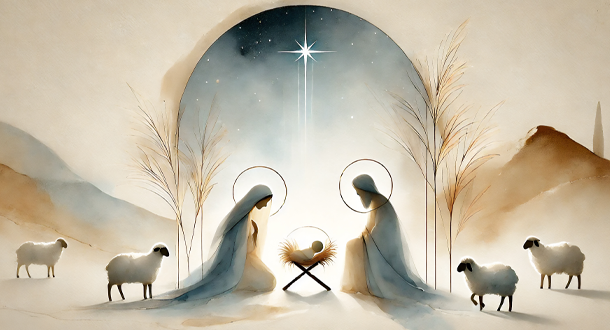



Like John the Baptist and Jesus, we are asked to stand honestly in the messiness of our lives, between hope and struggle, waiting and fulfillment, without grasping for easy answers. Faith grows when we remain faithful to our call, trust that God is present even when things feel incomplete and imperfect and allow room for different ways of living and expressing our faith and mission.
Indeed Flavie,
This is precisely why Luke’s gospel centers the birth of Jesus in the time of Caesar Augustus and Quirinius, two notoriously evil rulers. And Matthew’s gospel has Herod who is so enraged and jealous that he murders all the recently born males. Moreover, this family, who we now call the “Holy Family” is forced to flee for their lives. Today we call that forced migration.
I have to wonder what went through Joseph’s mind through all of this. For both Mary and Joseph, things would have been a lot more predictable if they hadn’t submitted their “Yes” before God. Faith then is faithfulness in the midst of tremendous chaos.