
Reflection
Today’s readings depict two memorable callings. The passage from 1 Samuel recounts how God summons Saul “to govern the LORD’s people Israel.” It is not surprising that God commissions Samuel to anoint Saul for God’s service because Saul “was a handsome young man” who “stood head and shoulders above the people.”
The story of the call of Levi in today’s gospel, however, is unexpected because Levi was a tax collector employed by the Roman Empire that occupied Palestine during Jesus’ life and ministry. As an employee of an oppressive power, Levi was despised by the Israelites; in fact, the late Passionist scripture scholar, Carroll Stuhlmueller, wrote that Levi was considered such an outsider that he could not even sit at the same table with devout Jews.
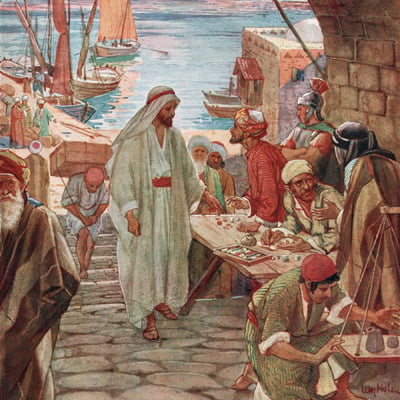
So, why did Jesus call Levi? The gospel suggests that sometimes God calls people who might seem woefully ill-suited to do God’s work because God sees goodness and gifts in them that we, and perhaps even they, do not see.
Even more perplexing, why did Levi respond to Jesus’ call without a second’s hesitation? He didn’t ask Jesus who he was, why he should follow him, or where Jesus would take him; he simply “got up and followed Jesus.” Moreover, there is no hint that Levi, who was fully occupied and seemingly settled in his life, was waiting to be called or even wanting to be called. Perhaps that means that God’s call comes on God’s time and according to God’s plans and purposes, not always when it is convenient for us.
Like Levi, when we answer a call, we never know where it will take us, what it might ask of us, or how it will change us. But we eventually discover that living our callings as fully and faithfully as possible, no matter how challenging they may be, is the key to happiness and fullness of life, because through our callings our lives are taken up into—and contribute to—God’s ongoing story of creative and compassionate love. Is there anything better to do with the gift of our lives?