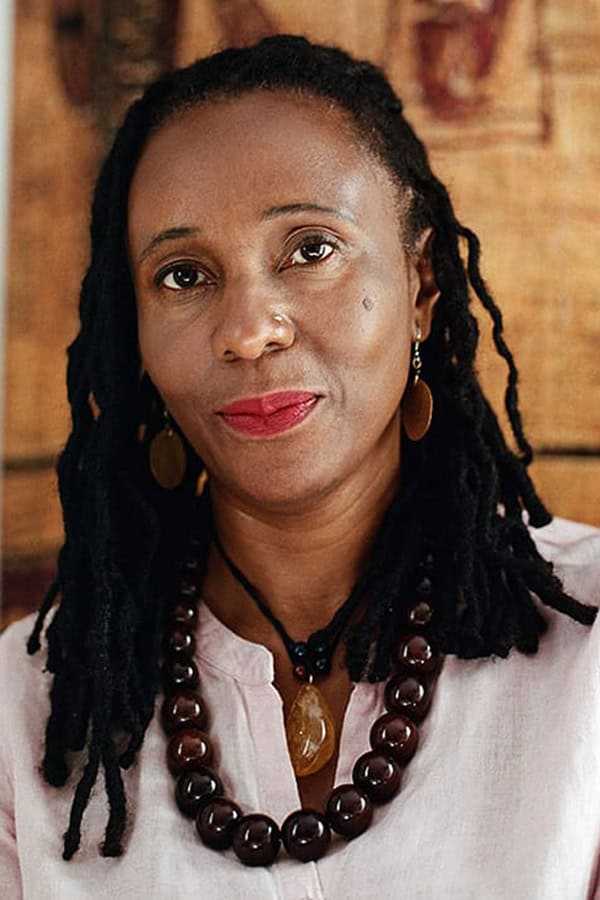
Every morning in her Bronx, New York, home, artist Laura James begins her day with prayer.
“When I think of prayer, I think of meditation. That is what I call prayer,” Laura explains. “I ask for things, but I also say thank you. I think, and I listen. Every morning when I get up it is the first thing that I do. I say thank you for waking up, and the day starts there.”
Laura maintains her meditative focus by listening.
“One thing that I do is listen to sounds—to nature sounds or singing bowls,” shares Laura. “The sound helps me to focus, the singing bowls in particular.”
Discovering the Power of Meditation
Although her current meditation practice is relatively recent, Laura has embraced prayer throughout her life.
“I have always prayed and had conversations with God, but I think I really discovered the power of prayer when I started to focus on things I wanted to happen in my life, and began to intentionally talk to God about it,” explains Laura. “I remember always wanting to meditate, but it was a year before Covid that I started doing it every day and making it part of my everyday life. Having that regular connection every day for a year really got me ready for Covid. You can be more steady when you pray regularly. You are not doing it yourself. I am protected, I am carried, and having that feeling is something I need to connect with a lot.”
“Every morning when I get up it is the first thing that I do. I say thank you for waking up, and the day starts there.”
Laura James
Bringing Prayer Into Her Art
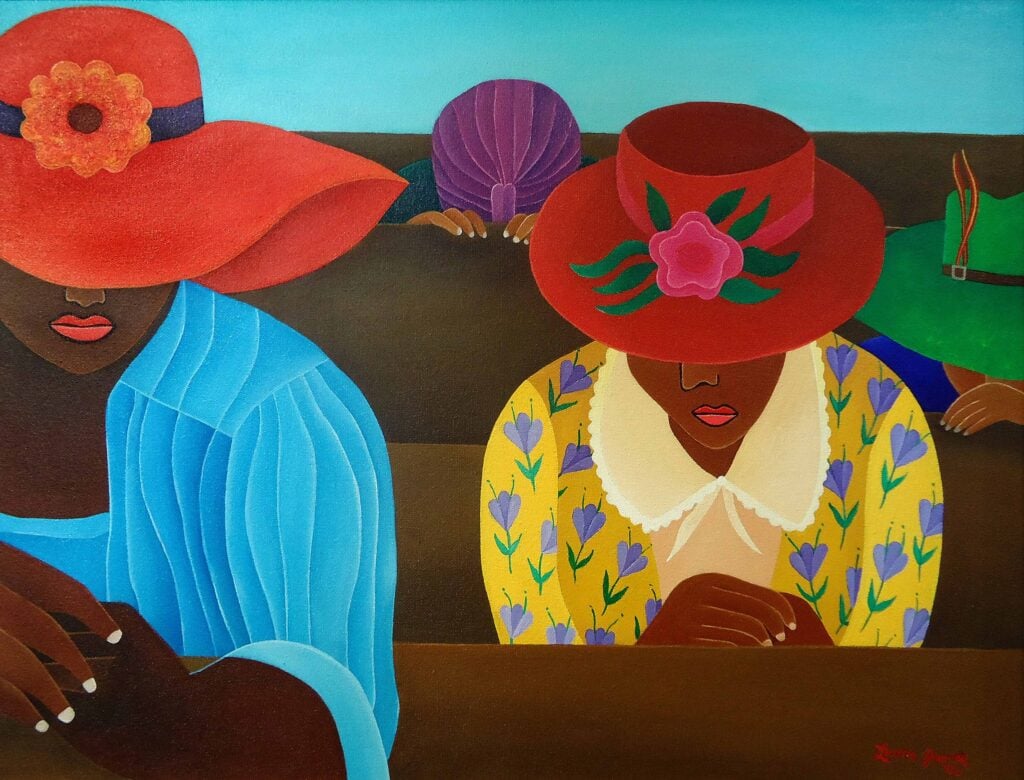
Many people have told Laura that her religious artwork carries a unique spiritual energy.
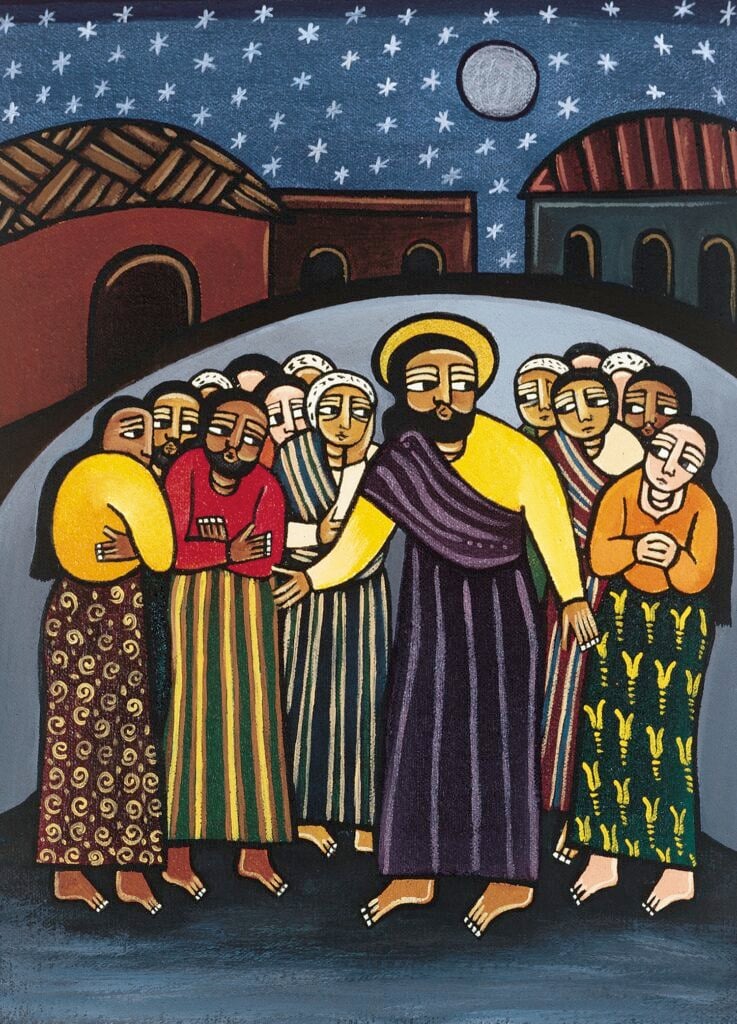
“They say Jesus always looks like He is with the people, and that is appropriate because His message was for the people,” says Laura. “It is a human story. It is not just a religious story.”
Prayer is an essential part of Laura’s creative process.
“I will say a prayer before I start painting and ask that the image comes out the way it is supposed to,” Laura shares. “I follow the Scripture text when I paint. I am not revising the text of the Bible, and I am not putting any spin on it. It is important that people are affected by the imagery. That is what I want, and it is for everyone. There are many people who appreciate the art and say they have nothing to do with religion. It can be universally appreciated.”
Trusting God’s Guidance
Laura recently completed a series of paintings of Mary Magdalene. During their creation, she experienced God’s presence in unexpected ways.
“We are souls that are connected to God’s energy, and we need that energy. That is nothing to be ashamed of. Embrace it!”
Laura James
“I was struggling at some points and working on a deadline, and I remember praying while I was painting,” explains Laura. “I remember distinctly a few times when the brush went in a random direction, and instead of having to wipe it off, there were good lines. It happened several times, and this is a new thing. My brush is doing something different, and I said, ‘Thank you very much.’”
Learning to Be Still
God often surprises Laura by answering her prayers with peace rather than immediate solutions.
“Many times, prayer has guided me to say, ‘Stop thinking about this. Do something else because this is going to be OK,’” she says. “It happens more and more now, that the ‘problem’ is answered by being still and going out into nature, rather than with the elaborate ‘solutions’ I conjure up. After feeling anxiety about something, it is still a bit amazing that the message from a prayerful meditation is to relax and trust that things are OK. That is not always an easy thing to do. It takes practice.”
Laura painting her vision into reality.
Inviting Others to Embrace God’s Love
One of Laura’s deepest prayers is that more people will connect with God through prayer and intuition.
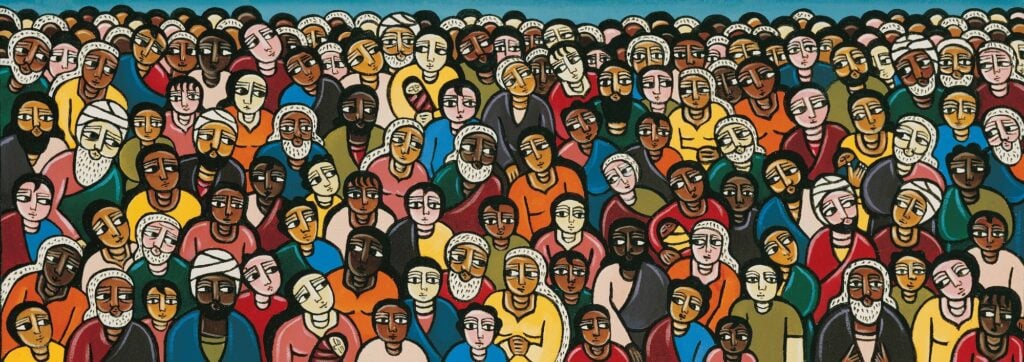
“We are souls that are connected to God’s energy, and we need that energy. That is nothing to be ashamed of. Embrace it!” shares Laura. “We need to be the peace and love people, as God is love.”
Learn More
To see Laura’s artwork, visit www.laurajamesart.com.
Extended Video Interview
This transcript has been prepared for clarity, accessibility, searchability and readability, though minor variations from the original video may occur.
Prayer as meditation
Interviewer: How is prayer a part of your day?
Laura: Okay, so when I think of prayer… I did look up the definition. I did a little Google, and it says “requests from God,” so I guess it’s like you’re asking for something. But when I think of prayer, I think of meditation. That’s what I think of, because I am a big meditator, and I call that my prayer. In doing that, I ask for things, but I also say thank you, and I also just think and listen. That is my prayer, and whenever I see the word “prayer,” I think of meditation.
So how is prayer part of my day? Every morning when I get up, it’s the first thing I do, usually before I get out of bed. Sometimes I’ll actually get out of bed and get on my knees or something like that, but the very first thing I do is meditate, to say thank you for waking up, and we start from there.
Building a relationship with God
Interviewer: That’s what everybody else has been talking about too: it’s not necessarily always requesting, but building a relationship with God, that connection. It’s important.
Laura: Yeah, and maybe it’s even like talking to God, quote unquote. Maybe that’s praying. Whenever you’re talking to God, you’re praying. I kind of see it like that, because when you’re meditating and in that space and you’re talking to God, whether you’re doing that in the morning or in the afternoon or whenever, that’s what you’re doing, in my opinion.
Interviewer: Right. Building that connection and that relationship is important, and at least for me, that helps keep me going. The listening part is a challenge for me sometimes, but I’m working on that.
Staying focused: nature sounds and singing bowls
Interviewer: One of the things I think people find challenging when they’re praying is staying focused on their prayer. That’s why I asked that question. Is there something you do to help you stay focused during your meditation?
Laura: One thing I do is listen to sounds. I listen to nature sounds or to singing bowls or something like that, because it helps me to focus. The singing bowls in particular, the chimes, even the rain, or the whales. I like to listen to whales sometimes. Just to hear nature sounds. I don’t know if a chime is a natural sound, but God is nature, and so that’s part of my meditation. That’s part of getting in the zone to talk to God: hearing those sounds. That’s one very big way I stay focused, by having that external thing to listen to.
Interviewer: I like that too. When I’m walking, I never have headphones on, even though I love music. Being connected and being out and hearing nature is part of how I try to connect with God when I’m walking.
Laura: And it’s always so funny, and I’m sure this happens to everybody who listens to things like this: when you think of something really poignant, that’s when they really chime that bell, or that’s when the birds start singing really loudly, and you know, “Oh, yeah, I’m on track.”
Interviewer: The feedback part.
Laura: The feedback, yes, exactly.
Discovering prayer: a daily practice before COVID
Interviewer: When did you first discover the power of prayer, Laura? Is it something you’ve been doing your whole life, or is it something that came to you later in life?
Laura: I think I’ve always prayed—asked and talked and all—but not formally, really doing it every day and making it a part of my every day. I’m really thinking about this now, and I guess it was maybe a year before COVID. So that’s actually not that long; it’s been about five years. But I remember always wanting to meditate, to do it every day, to do it as a practice. I had thought about it for many years before I actually did it. Maybe I would do it once a week or whatever, but about five or six years ago, I started to do it every single day, and it really does make a difference when you do something every single day.
Why did I start to do it? I don’t exactly know. Why do I do anything? Because I heard God tell me to, I guess. I got the vibe to start meditating regularly every day. I say it was the year before COVID because I remember when COVID happened, everybody was so freaked out, and I was too, but I was so much less freaked out than I think I would have been if I hadn’t been meditating for a year. I remember saying to someone that having that regular connection to God every morning for a year really got me ready for COVID and all the ups and downs. You can be more steady when you pray regularly, because you know that there’s some energy, some force—God has your back. You’re not doing this all by yourself.
I don’t know where this comes from, but things are going to happen whether we want them to or not. Life is happening. You can make plans and whatever, but prayer is really the best thing, in my opinion, because it just covers you for whatever, whether you think it’s a good thing or a bad thing. It’s like, no, this is just a thing that happens, and we’re going to get through this.
Talking to God about what you want
Laura: I think I discovered the power of prayer because I was thinking a lot about things I wanted to happen. But when I really thought about it, it was, “Oh, I want this to happen,” and then you think of all the reasons why it’s not going to happen. “I want to do this, but I can’t because of X, Y, and Z.” Then I realized I should stop saying why it’s not going to happen. I should just say, “I want this to happen. This is going to happen.” So I started to talk to God about it: “How is this going to happen? Okay, it’s going to happen. We’re going to work on this. We’re going to do this together.” It was sort of like a conversation. I’m not going to say, “It’s going to happen like this, and if that doesn’t work, I’m going to do that.” It was more, “I’m protected. I’m cared for,” let’s say. Having that feeling is something I needed to connect with a lot, so not just in the morning but all through the day. You pray, you check in, you say thank you.
Sharing meditations with her children
Interviewer: Do you pray together with your family at all?
Laura: Well, I am all alone, because my three kids are all gone, and my husband passed away, so I have no one here. But what I do do, and I don’t know if this counts, is send them meditations. Sometimes they’re guided meditations, or even sounds, like I said, because honestly, sounds are healing. Some sounds, anyway. As an aside, music that talks about all kinds of bad things is a sound that is messing with people, and that’s not a good sound. But the sounds of the whales—if you’re feeling depressed, listen to that for an hour. So I send my children meditations, affirmations, and prayers.
As children who didn’t necessarily identify with the Christian Church, let’s just say, it’s easier for them to think of it as a meditation than as a prayer. And it’s not just my kids; it’s a whole generation. They see things in the quote-unquote church that just don’t seem right, and so they don’t want anything to do with it. I also felt like that myself growing up, once I was old enough to know better. You kind of throw out the baby with the bathwater: not wanting to be religious, not wanting to go to church, not talking about Jesus. “Don’t talk about that.” And they don’t even know why they don’t want to talk about it. So I call it a meditation, even though we know it’s a prayer, and they like it. They’ve been doing them regularly, and that’s how I sort of got them into praying. And they’re coming back. They’ll come back too, because it’s good. It makes them feel good, and it makes them feel understood, I think, whereas organized religion maybe isn’t often like that. I think the prayer part of it, or the meditation part of it, is.
A favorite prayer from St. Teresa
Interviewer: Do you have a favorite prayer?
Laura: You know what, I’m going to tell you this one right here. It’s St. Teresa, and it’s: “Let nothing disturb you, let nothing frighten you. All things are passing; God never changes. Patience obtains all things. Nothing is wanting to him who possesses God. God alone suffices.” I’ve had this for 25 years or so, and I love it. It says, “Let nothing disturb you, let nothing…” I’m going to cry. “Let nothing frighten you.” That’s all you need, because we’re so scared of life and of things happening, and so we get freaked out or we get stuck or whatever because of fear. This has always really touched me.
Praying before she paints
Interviewer: How do you tie in why meditation is important to you and your art?
Laura: As far as the art is concerned, and not just for the religious work but for the secular work as well, I will say a prayer before I start painting and ask that the image comes out the way it’s supposed to, in the right way. I like to say that I follow the Scripture text when I paint. It might seem weird because the people are people of color or what have you—that’s the shocking thing—but the text is always the text of the Bible. I’m not rewriting the text of the Bible. I’m not putting any real spin on it. As an artist, I could do anything, but I want to depict what I’m reading. I don’t know if it’s my calling, but that’s what I want to do. I want to depict the Bible’s Scripture honestly. Whether I believe it all or not, if I’m painting from the Bible, I want to respect what I’m seeing there. I’m not going to make things up.
So I pray that I get it right, that my arm doesn’t start to hurt, that I have the energy and strength to finish the thing, and that when people see it, they are touched by it and it speaks to them, because that really is what I want. Whether you go to church or not, I want people to see the art and be touched by it, whether you consider yourself a heathen or whatever. I’ve had plenty of people appreciate the art who say they have nothing to do with religion. It goes beyond that in some kind of way, I think. I hope and I pray that this work can be universally appreciated, because it is for everyone. So that is something I pray for before I start.
Art that speaks to everyone
Interviewer: Do you get different feedback from people of different religions? Do people of different faiths see different things in the art or get touched by different parts? Or is it pretty much, “This was really powerful for me”?
Laura: It is kind of interesting. Mostly church people appreciate it because it’s something they maybe haven’t seen so much in their church. But church people or not, it’s just something human. I think we are souls connected to this God energy, and as human beings we need that. We need to be connected, and we are connected whether we want to be or not. Even if you want to reject God, you kind of can’t, because we’re all connected through our souls. The energy is all connected. So embrace it, and come and look at this picture.
One thing many people have said is that Jesus always looks like he’s with the people. He’s right down there in the paintings. He’s not off to the side; he’s right there with the people, because his message was for the people: love one another. So this is for everybody, not just for religious people. More and more, I would like to say that to non-religious people, and not to have my work so separate. I feel I have really separated the religious and the secular a lot, with the children’s books and so on. But the pictures of Jesus and the religious imagery are really a human story. It’s not necessarily just the Bible, and I believe that’s true, though maybe people in organized religion might think there’s more to it.
Mary Magdalene and the Ethiopian Christian art style
Interviewer: I loved the Mary Magdalene, because she’s one of my favorites, and being able to see her progression was really powerful.
Laura: She is not appreciated the way she should be. She was literally the first person Jesus talked to. How can it be that women are marginalized, like second-class citizens, like we’re less than? How is that possible, when Jesus was resurrected and came to talk to her and told her to go tell everybody? It says that in the Bible; we didn’t make that up. I think anybody can look at the Mary Magdalene story and say, “Wow, this is a powerful woman.”
I recognize that people who go to church faithfully appreciate seeing these images. I want to say “non-traditional,” but the Ethiopian Christian art style has been around since the fourth century, so it’s very traditional. It’s not non-traditional; it’s just not Western, I guess. People want to see non-Western people depicted, but they also want to see Mary Magdalene. They want to see Jesus standing on the cross and not suffering, like in the Sewanee cross that I did, which is the way he was depicted originally. So once again, it’s going back to the Bible and illustrating it the way it’s written there. It’s stripping things down, taking away the commentary, and just showing what is written, for better or for worse.
Be the peace and love people
Laura: I hope we can reclaim that: the Bible story, the Jesus story, the message. And it’s just Jesus’s story, by the way. There are other masters who said these same kinds of things, and there are other religions. Surprise, surprise, there are other people who believe other things. I think we need to get together more—ecumenical, non-denominational, whatever it is. We need to get together more. We need to be the peace and love people. That’s what I like to say. We don’t want to be the death people and the war people and the hatred people. We want to be the peace and love people, no matter what your religion is, because really, peace and love is a religion.
Prayer’s surprising answer: relax
Interviewer: Has God guided you in prayer in a way or a direction that surprised you?
Laura: Just let go and go with the flow. Many times prayer has guided me by saying, “Stop thinking about this.” And it’s always kind of a surprise, still. Not always, but usually the answer is just, “Relax about it. Go do something else. Go listen to some music or read a book, or go paint. Do something else. Don’t worry about this, because it’s going to be okay. It’s going to work out.” When I pray and I get that feeling, it’s always a surprise to me: “Oh, okay, I’m just going to relax.” One day it’s not going to be a surprise anymore, and I’m going to continually relax. That’s the goal, because things keep coming up in life, and I’m like, “Oh, what am I going to do?” You pray about it, you meditate, you think about it, and you get the inspiration to relax, go with it, and know that you’re going to be okay. That really does surprise me, even though it shouldn’t anymore.
Prayer at the easel: painting Mary Magdalene
Interviewer: What role does prayer play in your ability to create works of art?
Laura: Especially with Mary Magdalene, because I had been working on it for a really long time, and I needed to finish. I remember praying as I was painting and asking, “Make this go smoother. Let this work out well. Show me how to paint this thing.” A few times I made marks with my hand that I wasn’t consciously making, and they worked. They were good lines. It wasn’t something I needed to erase. It was, “Oh, okay, let me go in that direction.” It happened several times, so I made a mention of it. And this is a new thing. I’ve been painting for 30 years now, and this just happened a few times this year, working on Mary Magdalene. I remember very clearly my brush doing something different, and I said, “Thank you very much,” because I asked for that. It wasn’t just randomly making mistakes. I said, “Help me to do this better.” That was a surprise.
Interviewer: That’s awesome. Mystical.
Laura: I don’t know if it’ll keep happening.
Why we ask
Interviewer: Oh, I think it will. I do that a lot when I’m writing or before interviews. I always ask for intervention: “Help me to hear what I’m supposed to hear. Help me to write what needs to be written.” There are times when I’m completely distracted and not able to do it, and then I ask for that help, and it all flows really well. So I know it’s not just me. It’ll keep happening, Laura, as long as you keep asking. I think we’ve got to ask.
Laura: Exactly. We have to ask, and that’s why prayer is important. I don’t believe God is going to not look at us or not know we’re here if we don’t pray, but it’s even better if you do. And it makes me feel good. It makes me remember, which is something we constantly need to do when the Earth is a little negative. It’s good to keep your vibration high, and I do that through praying, through meditating, and through constant communication with the energy that is guiding all of us, otherwise known as God.
Interviewer: That’s perfect.
For beginners: guided meditation and the Psalms
Interviewer: What kind of prayer practice would you recommend to somebody who’s new to prayer?
Laura: Those guided meditations and listening to nature. There are so many apps. It sounds totally crazy. If my mother asked me about praying and I told her to get an app, she’d say, “What are you talking about?” But especially for young people, and for people who don’t want to pray, or don’t think they need to, or don’t know anything about it, or don’t think it’s for them, tell them to listen to a meditation.
And one thing I love is the Psalms. Even if you’re listening to somebody read the Psalms—you can find that online easily—that is meditation. That is prayer. So if you don’t know where to start, hey, listen to the Psalms. They cover all of it: there are happy Psalms, sad Psalms, “I’m really angry” Psalms. And honestly, all through my growing up, even when I rejected church, I always read the Psalms and listened to the Psalms, because they’re poetry, and they’re mostly uplifting. There are some bits that are not, but they’re mostly uplifting, and they make you feel good. I think that’s what we want to do when we pray: raise our vibration so that we feel better, because I don’t want to feel bad, and there are so many things that can make us feel bad. If you listen to the news and things like that… You want to keep your energy up, stay positive, and have a positive outlook, even if things look really, really bad.
Prayer is for everybody
Interviewer: Is there anything else you were thinking about that we haven’t talked about yet?
Laura: I would just like to make the point that prayer is for everybody. It’s not just for the religious people and not the non-religious—all these words: spiritual, Catholic, Christian, whatever you are, Islam, Jewish, whatever. Prayer is for everybody, because it’s something good for human beings to do. I don’t want to tell people what to do, but prayer is good. It will let you realize you are connected. You are connected to something bigger than just you, whether it’s God or other people or the environment—the whales, when you listen to the whales. And just generally having a positive attitude in the face of bad stuff, because it’s going to happen anyway.
Interviewer: That’s right.
Laura: So you might as well let it happen with a smile.