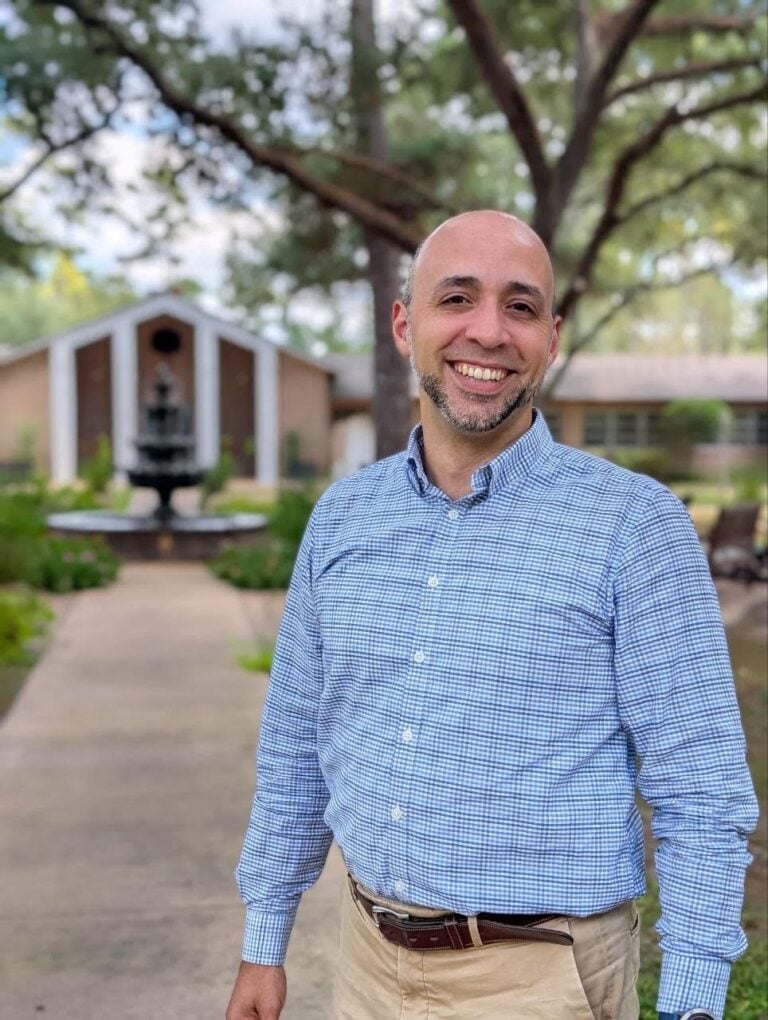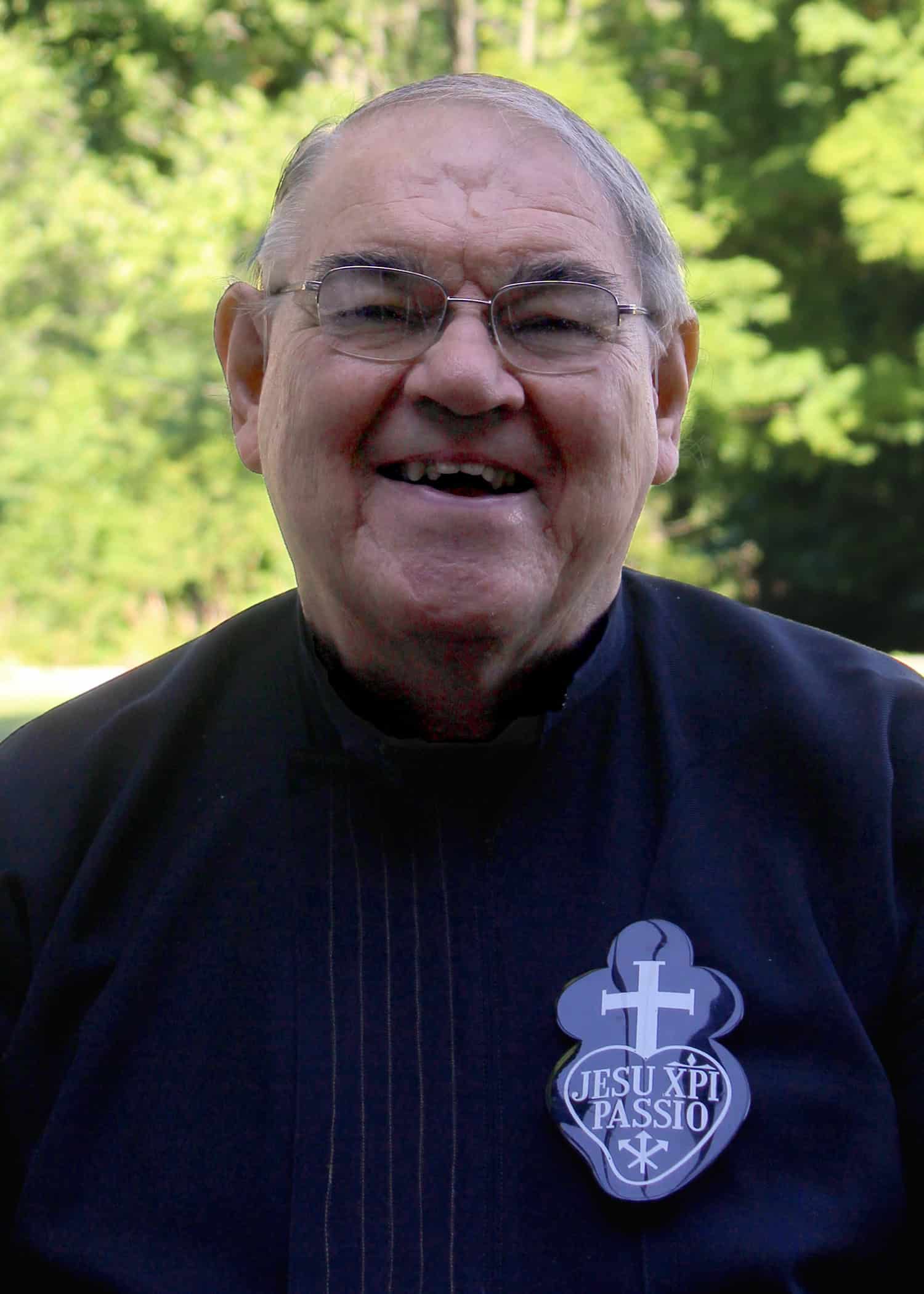
Brother John Monzyk, C.P., joins his fellow Passionists every day in communal prayer at Sacred Heart Monastery in Louisville, Kentucky. Prayer also finds its way into many quiet moments throughout his day.
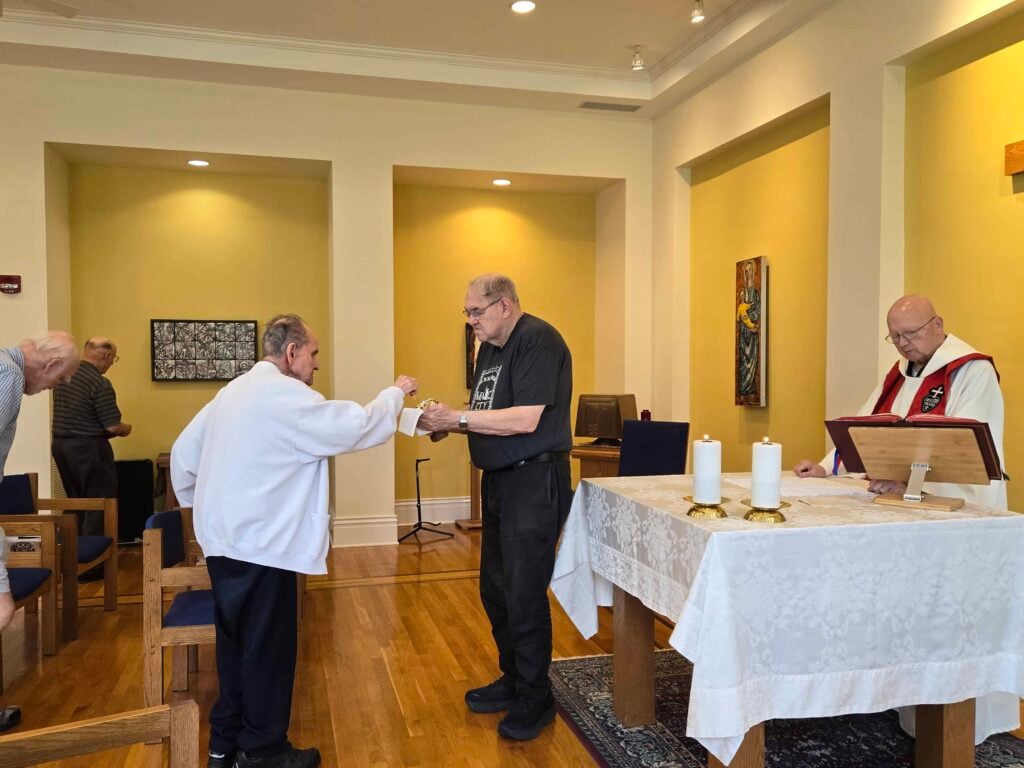
“I think prayer for me is what we do,” says Brother John. “We meet at 11:00 a.m. and have morning prayer and then we have Mass at 11:15 a.m. If Mass does not go for an hour, I stay and pray. In the afternoon, we have prayer at 4:45 p.m. Sometimes, after lunch, I like to get my cola and chocolate, and that is a time when I have some quiet time. For me, that is a refreshing time.”
Finding God in Science and Creation
Brother John spent much of his life immersed in science as both a student and a teacher, yet he has always found room for God. He sees God’s presence in the sunset outside the monastery and in the dog who accompanies the cook each day.
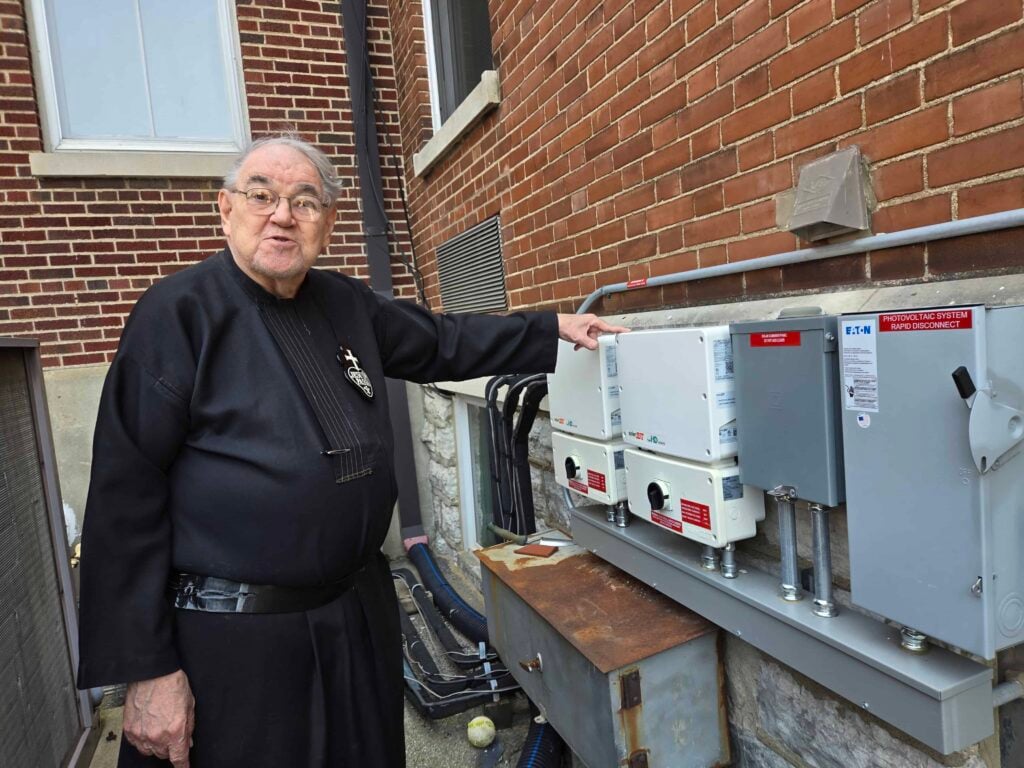
from the solar panels is transferred to the batteries, where it is stored until used.
“I am a scientist by training. I realize God is a part of everything,” Brother John explains. “There had to be a God to do this. At 75, I realize I am still here, and I am still a part of all this wonder and a part of this thing called life. And this might be the only place in this whole universe where life is happening, and that brings me wonderment.”
A Quiet Faith
Growing up, Brother John’s parents rarely spoke about religion or their Catholic faith, but their example left a lasting impression.
“Our religion ran quiet and deep. I remember being downtown in our hometown with my mother. Earlier that day, she lost her watch while making the beds and found it after saying a little prayer to St. Anthony,” shares Brother John. “She said, ‘Before we go home, I want to stop in church and say a little prayer of thank you to St. Anthony.’”
Prayer Changes the Person Who Prays
For Brother John, the power of prayer lies less in changing circumstances than in changing the heart.
“I often think of the power of prayer and what prayer has the power to change,” explains Brother John. “As a scientist, I wonder, ‘Does God move things that would not be moved by forces of nature? Am I looking for something outside of me to move or looking at something inside of me to move?’ I think it is the latter. Prayer makes us more appreciative.”
He recalls a time when he narrowly avoided hitting a deer while driving. After swerving, his car fishtailed but never crashed.
“It really spooked me,” he says. “Why did I not have a wreck? I had the sense that somebody there helped me out. God and my guardian angel got some thanks for that incident.”
A Spirit of Thanksgiving
While many people approach prayer as a time of asking, Brother John’s prayer life is centered on gratitude.
“The big thing about prayer is not always getting your way. My stance in prayer is basically thanksgiving.”
Br. John Monzyk, CP
“The big thing about prayer is not always getting your way. My stance in prayer is basically thanksgiving,” he explains. “The Eucharist means a lot to me. As a high school student, I decided to go to Mass daily, and I have been pretty good about that.”
The Passionist Brother’s Vocation
Brother John believes the prayer life of Passionist Brothers reflects the active ministries they embraced throughout their lives.
“The Brothers have been more active in their lives, so I think our prayer life tends to be more practical,” shares Brother John.
“Brother Ray (Sanchez) worked at Cook County Jail. He has had some real experience at leading people in their spiritual life. I have been a teacher of science and math, and my spiritual life with students has been a little different. Brother Kurt (Wernert) ran Christ the King Retreat Center in Citrus Heights, California.”
“I am a scientist by training. I realize God is a part of everything. There had to be a God to do this.”
Br. John Monzyk, CP
Always in God’s Presence
Whether his prayer is formal or informal, Brother John begins the same way.
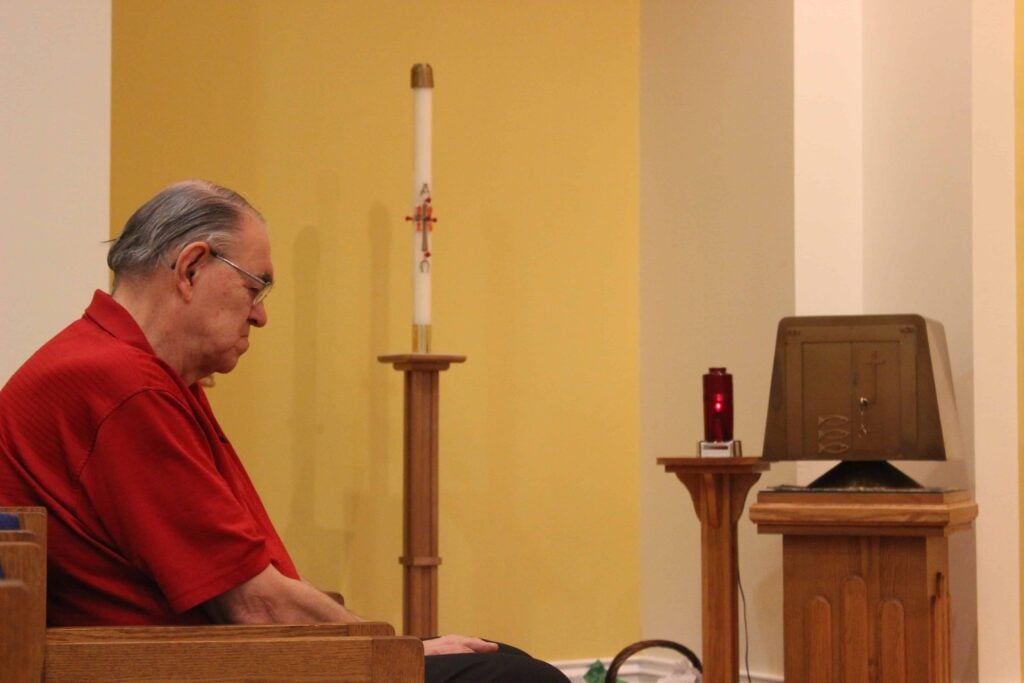
“When I want to spend some quiet time, I begin by remembering I am in God’s presence. That was the call to quiet during student life. And I remember I am in God’s presence wherever I am.”
Extended Video Interview
This transcript has been prepared for clarity, accessibility, searchability and readability, though minor variations from the original video may occur.
The daily rhythm of communal prayer
Interviewer: How is prayer a part of your day?
Br. John: Well, a lot. I think prayer, for me, is pretty much what we do. We meet at 11:00 in the morning for morning prayer, and then we have Mass at 11:15. If Mass doesn’t go until 12:00, I pretty well stick around and finish off that hour of prayer for myself. Sometimes I have to get going, but I typically do that. Then in the afternoon, we have evening prayer at 4:45. So that is our communal prayer for the day. At various times during the day, guys will be in the chapel and so forth, but those are our observances as the retired community for the province. That is our routine.
Quiet time: a cola, chocolate, and the news
Interviewer: Do you find yourself in prayer at other times throughout the day?
Br. John: I have to admit that I don’t regularly have a scheduled time. But sometime after lunch, I like to get my cola and chocolate, and that is a time when I’ll catch up on the news and just have some quiet time. For me, that’s a refreshing time. It’s not that my schedule keeps me too busy, but it does keep me kind of busy with just the little things.
Caring for aging religious
Br. John: Right now, with Brother Kurt bouncing back from knee surgery, I’m finding that I’m doing more things for our aging religious and jumping in at places where he would normally have been doing some of that. I’ve always had an interest in the physical plant, so I’m chasing down electrical things and things in the heating. I used to be able to fix more of those, but at 75, I find that I basically want to keep an eye on them and call in somebody who knows what they’re doing. That’s how my day goes.
Sunsets, space telescopes, and the presence of God
Br. John: But a few minutes on the back porch, looking at the sunset… For myself, I get surprised once in a while by something that brings to mind the presence of God. I’m a scientist by training. I often think, “Does God need to be a part of this?” And then I realize God is a part of everything. You see a sunset that just wows you, or even something on television from the new space telescopes, and you just say, “God had to do this. There had to be a God to do this.”
I’ve also been thinking recently that at 75, I probably have just single digits left, and I realize that I’m still here and I’m still a part of all this wonder. I’m still a part of life. Right now, this is the only place on Earth, in the universe, where we’re absolutely sure there’s life. And if you ask whether there’s life elsewhere, the only settling answer will be yes, because if the answer is no, we’ll keep looking.
Kelly’s dog and the wonder of life
Br. John: And just little things. The cook, Kelly, brings her dog every day, and he is the gentlest thing. He’s so faithful and doesn’t bother anybody. When the mailman comes and rings the doorbell, he barks, and I tell him he barks only because he’s afraid somebody’s going to get between him and the new friend he might make. Even though I’m a physicist, it’s life that amazes me right now, just to be a part of all this wonder that’s going on. It’s moments like that. That’s where I am in my spirituality.
A faith that ran quiet and ran deep
Br. John: I learned from my parents. In our house, religion was something that ran quiet and ran deep. There was no doubt you were going to Mass on Sunday, but it was not talked about. There was no meat on Friday; it just wasn’t there. That’s the way my family was. Religion wasn’t something that was talked about all the time. It was just something that was there and was important.
His mother’s prayer to St. Anthony
Interviewer: When did you first discover the power of prayer, Brother John? I know it wasn’t necessarily something that you talked about, or that you had a formal focus on in your life, but how has it played out in your life to guide you?
Br. John: When I read that question, I immediately thought of my mother. I remember being downtown in our hometown, and she said, “Before we go home, I want to stop in church to say a little prayer.” She said she had lost her watch, and she was making the beds, so she knelt down by the side of the bed and said a prayer to St. Anthony. As she was getting up, she found it on the bed. [Laughter] She’d decided to say a little prayer, and there it was, and she wanted to say a prayer of thanks to St. Anthony. So we went by the church.
What does prayer change? A scientist’s view
Br. John: I often think about the power of prayer and what it has the power to change. As a scientist, I often think: does God move things that would not normally be moved by forces of nature? I think the biggest thing it moves is us. Am I looking for something to happen outside of me because I pray, or am I looking for something to act inside of me because I turn to God? I think it’s the latter. I think it makes us more tolerant, more appreciative of nature, more appreciative of things around us, and more open.
Growing up, my best friend was not a Catholic, so he worshiped differently than I did, but that taught me respect for what he did. I think those little experiences teach you what prayer does in your life. In general, it’s not making great miracles happen.
A close call on I-64
Br. John: Though when I’ve had close calls, I’ve believed that God has been part of it. Several years ago, in the early evening between St. Louis and Louisville, there was a deer in the middle of I-64. I was doing about 70, and I swerved and fishtailed, and when I finished fishtailing, I was still headed for Louisville. It really spooked me. Why didn’t I have a wreck? You sort of sense that somebody helped you out there somehow. The guardian angel and God both got some thank-yous for that one.
A stance of thanksgiving and the Eucharist
Br. John: And just the good things that have happened, the parents I had… It makes me thankful. I think my stance in prayer is basically a stance of thanksgiving, and so the Eucharist means a lot to me. As a high school student, I pretty well decided I wanted to go to Mass daily, and I’ve been pretty good about that, and not just because it’s part of our routine around here. If the big thing about prayer is not always getting your way, it’s being thankful for the life that you’ve had. And Eucharist means thanksgiving, so that’s an integral element of my life.
Prayer practices of the senior Passionists
Interviewer: What would you say the prayer practices are for the senior Passionists in Louisville? Are there any special things that you all do?
Br. John: Not typically. If there’s a mission at church, we do, and on some days… But it is still just part of the routine. We don’t have Mass here in the monastery. It’s up to the individual, but we attend Mass at St. Agnes, and I encourage the guys to wear their habits, because the people want to see Passionists. Everything around here really screams that the church and the monastery did more things together in the past, and so several years ago, we decided that on Sundays we would attend Mass at St. Agnes.
Our sanctuary here has what we call the Horseshoe. It swings around the back of the altar, and that was where the guys would sit when there were solemn Vespers and so forth that they participated in. So I sit up there, and I walk out and greet people afterwards. We don’t frequently have formal things outside of that. We do say a prayer before supper, a thanksgiving for supper. We do that. But basically, it’s morning prayer, Mass, and evening prayer.
How prayer grows in retirement
Interviewer: Have you seen the prayer ministry in Louisville at the monastery grow over the years in different ways?
Br. John: I think it grows in individual men as time goes on. Guys come here from active ministry, and they want to remain active, so if they can, they will typically link up with St. Agnes. Priests hear confessions at St. Agnes, and that could even be on a regular basis. On Saturday evening, Father Kenneth went over and heard confessions. The diocese has priest support groups, and one of them meets here, and a couple of our guys attend that. That is a ministry this house easily conducts, because all we have to do is provide a little bit of lunch, and I get a confessor out of it.
I noticed that Father Sebastian MacDonald, as he got close to the end, was always a walker, so he took his solitary walks at least twice a day, but I would find him in the chapel more often. He knew that life wasn’t going to last forever, so he decided he was going to be in the chapel more. Dick Thompson is always the first one in the chapel. Most of us scramble to get there on time. He’s not a chapel dweller, in that he’s there all the time, but just before observance, he gives himself a little bit of private time. So I see the personal prayer life of the guys change as the individual needs it.
Some of the other things… Father John Patrick Day has been assigned here for a number of years but has mostly been in Tennessee at a couple of parishes. He’s come home now, and he is still going out to various parishes, though not regularly to a given parish.
Senior care and ministry that continues
Interviewer: From what you’re telling me, you find that the priests coming to the monastery are able to be more introspective and have more time for prayer themselves and to be immersed in it more, which makes sense, than when they were busy working all the time. But as long as possible, they want to be active and out with people too.
Br. John: And in this community, having Brother Kurt as the Director of Senior Care takes a burden off of them, having to do a lot with their health care. He will help them make their appointments, he’ll get them to the appointments, and he’ll see to even little things, like seeing that their pill planners are taken care of. If he notices something, he’ll get them to the doctor and help them.
Father Chris recently fell two days in a row, and the first day was the day after Brother Kurt’s knee surgery, so we spent a couple of days in the emergency room with him. But Kurt worked hard to get him into Nazareth Home. I’m impressed with Father Chris, because he is continuing some of his mail ministry, and he asked for his guitar the other day. So he’s continuing to help people with their prayer life at Nazareth Home.
Interviewer: Well, that’s a blessing, to be able to do that. It gives you a purpose. We all have to have our purposes, no matter how big or how small. And I’m sure you find it a blessing, with all you do for the men at the monastery, to be able to take care of them, knowing that they worked hard in their lifetimes to do for other people. It’s a gift.
Prayer then and now
Interviewer: We’ve sort of been discussing this, so I don’t know if there’s anything different, but would you say the prayer practices for the senior Passionists are the same now or different from when they were in active ministry?
Br. John: I would say it’s pretty much the same. This is pretty much the pattern in our communities: morning and evening prayer, and daily Mass would be the big things. There are opportunities. We have community meetings, and you open those with prayer. I guess some communities would have days of recollection. We’ve had some retreats here since I’ve lived here. We’ve had community retreats where we had somebody come in and conduct them. One year, a group of us went up to St. Meinrad and just spent some quiet days there and prayed with the monks in their chapel.
Four brothers at the table: the brother’s vocation
Br. John: Right now, it’s kind of funny: we have four brothers here and only about seven people living under the roof. We used to call ourselves the Passionist Fathers, so sometimes meals of the Passionist Fathers consist of four brothers. And of course, the brother’s vocation is the least understood in the Church. So often I introduce myself, “Hi, I’m Brother John,” and the reply is, “Well, how are you, Father?” after what I just said. I try not to correct it all the time.
The focus of the brothers and their activities are just a little different, though not so much the goal in prayer life. We all say we preach Christ crucified, and that means preach in the sense of St. Francis: use words if you have to. The brothers have probably been more active in their lives doing… I hate to say worldly things, because it’s all about dealing with God’s creation. So I think our prayer life tends to be more practical.
Brother Ray has worked in the Cook County Jail, so he has had some real experience in leading people in their prayer life. I’ve been a teacher, a teacher of science and math, so my spiritual influence with students has been a little different, but I know it’s been there too. I normally opened class with a prayer and so forth. Brother Kirk has run the retreat house in Citrus Heights. So we’ve all had different experiences. But what I don’t have, I would say, is the deep experience. I think for a priest, confession must be a really special ministry, and I haven’t had that.
Finding his calling as a Passionist brother
Br. John: Personally, I entered the Passionists thinking I wanted to be a priest. What I found out when I was a student here in Louisville was that I was in love with religious life. I loved the Passionist way of life and what we do. But when they would talk about specific things of priesthood, that didn’t interest me, and I thought, “This sure sounds like a brother’s vocation.” I switched at the end of college and never looked back. That was it for me. That help came from Michael Houlahan, one of our priests, who was my spiritual director at the time.
I think some guys probably have more of an opportunity to pray and to be in community regularly. I know Father John Patrick didn’t experience community all those years he was in parish life. He wasn’t in Passionist parishes; he was in diocesan parishes, some in Japan, some in Europe.
Interviewer: How wonderful that you discovered that about being a brother and were able to follow that path with the Passionists. That’s a pretty wonderful opportunity.
Something to be thankful for: teaching and his parents’ story
Br. John: Well, it was. Talk about something to be thankful for. When I said I wanted to pursue teaching, the Passionists got me all the way through the PhD, and I ended up teaching at Christian Brothers University in Memphis for seven years. That this community would put that faith in me…
As I told people when I was celebrating my 50th, it took my parents 15 years to tell me the story of the evening after they dropped me off at the seminary. We lived about 25 miles from where my class was meeting, and Mom was crying on the way home, having given up her only begotten. Dad turned to her and said, “I don’t know what you’re crying for. You’ve got him so spoiled, he’ll be back in six months anyway.” I’ve said since my 50th that what Dad didn’t realize was that the Passionists would spoil me.
One of the Sisters of Charity of Nazareth I talked with at Holy Family in Birmingham said to me one time, “Brother John, somehow you’ve got to learn to bicker.” When you’re young, with brothers and sisters, you learn to bicker.
Leading a community that prays
Interviewer: What would you say the challenges are in leading a prayer ministry with your retired brethren?
Br. John: I would say up until a few years ago, it was trying to get them to agree on anything a little unusual, but we lost the guy… If I’ve learned anything about the Passionists, it’s that there’s diversity, and there’s diversity in the amount of tolerance guys have. You get some who almost want to reject anything that is older, and you get guys who are convinced we’re coming back to all of that. So I don’t know just how much of my job is… I’m leading a community that prays, but I don’t think I’m leading much of a prayer ministry. I don’t spend a lot of time trying to introduce alternate forms of prayer. When it comes up, it seems the guys are tolerant and appreciative.
Interviewer: It sounds like you go with the flow and with what works, as opposed to trying to make everything change or form it in a different way, which is good, because then it’s more dynamic and organic.
For beginners: remember that you are in the presence of God
Interviewer: Do you have a preferred prayer practice that you would recommend for somebody who is new to prayer?
Br. John: I think a lot of it is the old Passionist way. We usually begin with, “Let us remember that we are in the presence of God.” That was the call to quiet in student life. We would be out recreating outside and come in for evening prayer, and it wasn’t “Shut up and be quiet.” It was, “Let’s remember we’re in the presence of God.”
Personally, when I sit down in the chapel and I’m going to spend some quiet time there, that’s where I begin: remembering that I’m in God’s presence. And I remember I’m in God’s presence now anywhere I go. If a sunset or some beautiful scene is reminding me of that, it puts me in a little bit of a state of prayer. That’s where you begin: remember that God is present here.