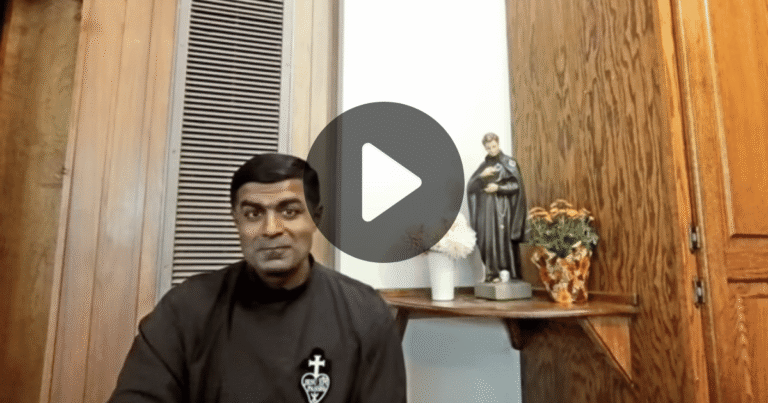
What does the cross have to do with the environment? On the Feast of the Exaltation of the Holy Cross, this homily explores how the cross—once a symbol of death—becomes a tree of life rooted in love, stretching wide to embrace all creation.
Beginning with the story of a village olive tree, we reflect on how the cross teaches us peace with creation. From the bronze serpent in the desert to Christ lifted high, the cross heals, restores, and calls us to live differently: not as masters of the earth, but as members of its family.
This reflection weaves together scripture, Pope Francis’ Laudato Si’, and real signs of resurrection today—young people rising to defend the earth, parishes going green and communities caring for one another and creation.
Watch and be inspired to lift high the cross with your life: rooted in humility, raised in hope, stretched in love.
To receive text reminders of our Passionist Season of Creation content, text PASSIONISTS to 43506.
Message and data rates may apply. You can opt-out at any time.
Transcription
The Story of the Witness Tree
In a small Mediterranean village, right in the middle of the town square, stood an old olive tree that had been there for centuries—long before there were roads or even a church. The villagers called it the Witness Tree because it had seen everything: weddings, funerals, newborns, homecomings, even wars and celebrations of peace. It was like part of the family.
One year, a developer came with big plans to build a shopping mall. But the tree had to go. Many people were excited about the promise of progress and jobs. But one old man, Elias, stood up and said, “You can build many malls, but you cannot plant a tree that has prayed with us for generations.” His words struck a chord. The villagers changed their minds, and—surprisingly—the developer offered to fund a community garden around the tree. It became a place of peace and gathering. Children learned how to grow food, neighbors shared stories, and the tree stood tall as it always had, sheltering the life around it.
Years later, a young boy asked Elias, “Why did you fight so hard for that tree?” Elias replied, “Because it reminded me of the cross—rooted in the earth, reaching to heaven, and giving shelter to all who come near.”
The Feast of the Exaltation of the Cross
Today we celebrate the Feast of the Exaltation of the Holy Cross—a day when we lift high the cross, not as a symbol of defeat, but of victory, healing, and love. This year, we do so with a special focus: peace with creation. And we might wonder, what does the cross have to do with the environment? What does Jesus dying on a wooden cross 2,000 years ago say to a world facing pollution, climate change, and disappearing forests?
Healing Through What Is Lifted Up
Let’s go back to the first reading. The Israelites in the desert were complaining, tired and suffering. God told Moses to raise up a bronze serpent on a pole. When the people looked at it, they were healed. Strange, perhaps—but a powerful symbol: something lifted up that brings life.
In the same way, Jesus was lifted up on the cross, not to punish us, but to heal us. And healing begins when we recognize the wounds.
The Wounds of Creation
The truth is, our planet is hurting. We see it everywhere—forests being cut down, oceans filled with plastic, animals going extinct, climates growing more extreme, and millions displaced by famine, violence, and hardship. Pope Francis, in Laudato Si’, said something honest: we’ve treated the earth as if it belongs to us, as if we can take whatever we want, whenever we want—and it is catching up to us.
The Cross as a Tree of Life
But here’s the good news. The cross is not just a reminder of death; it is a tree of life. It shows us a better way to live because it is rooted in love. Its arms stretch wide to embrace everyone and everything: people, animals, rivers, forests, the air we breathe. It invites us to live differently.
That’s what peace with creation really means. Not just avoiding pollution or recycling, but learning to live in harmony—as part of the family of creation, not as its boss.
Living the Cross in Daily Life
So we ask: how do we exalt the cross today? Not just by placing it on a wall or carrying it in procession—though those things matter—but by living Christ when we choose kindness over convenience, when we tend a garden or clean up a beach, when we walk instead of drive, or when we plant a tree.
We exalt the cross when we see God not only in church, but in creation: in a bird’s song, a child’s laughter, the shade of a tree, or families reunited. And we remember this: the cross, the crucified Christ, is not the end—it leads to resurrection.
Signs of New Life
Even now, there are signs of new life: young people standing up for the earth, communities switching to renewable energy, parishes starting green ministries, farmers bringing life back to the land, neighborhoods protecting and welcoming migrants and refugees. These are little resurrections—new life springing forth from love and sacrifice.
Lifting High the Cross
So, my dear friends, let’s lift high the cross today not just with our voices, but with our lives. Let it root us in humility. Let it lift our hearts in hope. Let it stretch our hands in love toward our neighbors and toward the earth.
And may Christ crucified teach us this: that real peace is not just the absence of conflict, but the presence of love, justice, and care—for one another and for all that God has made.
Amen.