

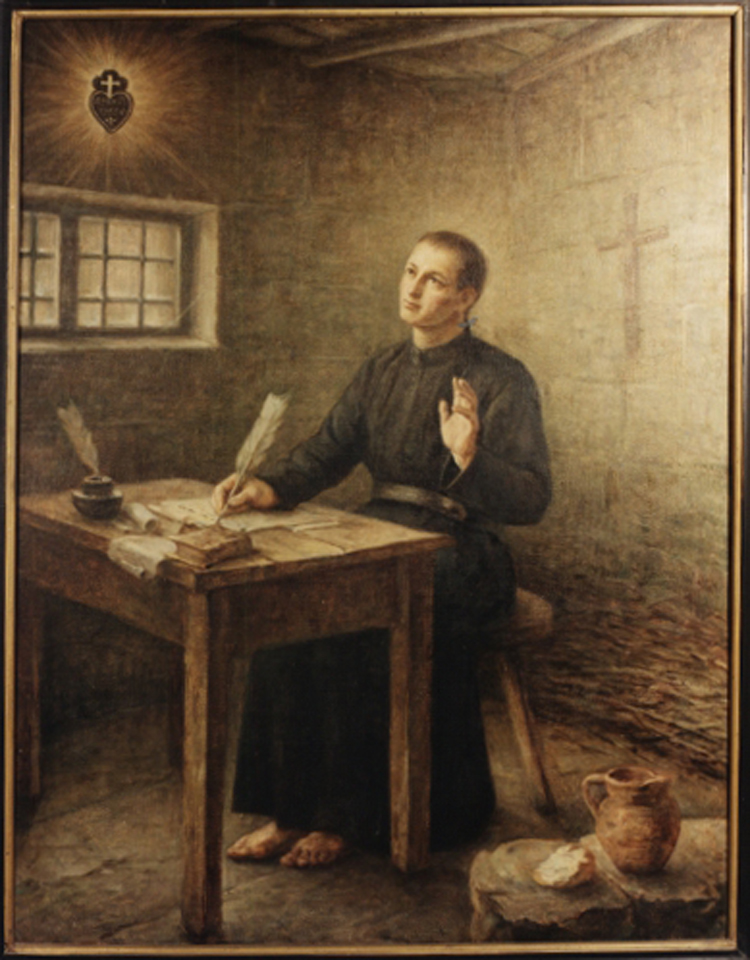
Today, the worldwide Passionist Congregation marks the 250th anniversary of the death of St. Paul of the Cross. It is humbling to remember that what began in his childhood, when he and his brother prayed the Divine Office in the attic of their family home, has bloomed into a vibrant and diverse community that spans the entire world. With such an important milestone, this is a perfect moment to look back and reflect on how our charism has developed and matured through the centuries.
The Life and Spiritual Vision of St. Paul of the Cross
Beginning with the life of St. Paul of the Cross, we can see two distinct expressions of his deep conviction about the Passion of Jesus.
The first expression was interior. The Passion of Jesus was the living center of Paul’s personal spirituality. It was not an instant revelation but a lifelong unfolding. The passion shaped his prayer, his preaching and his spiritual direction, deepening gradually through years of experience and reflection. His letters, especially those written to Agnes Grazi and Thomas Fossi, reveal this development in his theology and spiritual guidance.
In them, we see a man who grew into a mystic of the cross, whose every letter was filled with love for the passion of Christ.
The second expression was communal and apostolic. Paul understood that the message of the Cross was greater than any one person. It was meant to be lived and shared within a community of faith. For this reason, “he gathered companions to live together and to proclaim the Gospel of Christ to all.” (Constitutions, 1-1) This insight led him to write the Rule and to formally establish the Congregation of the Passion. We frequently forget how much time and energy Paul invested in establishing the Congregation.
Understanding Charism in Historical Context
It is important to note that Paul never used the word charism to describe the gift entrusted to him. In fact, the first magisterial use of charism to describe the distinctive gifts of religious communities did not appear until 1943, when Pope Pius XII issued the encyclical, Mystici Corporis Christi. In that encyclical, the Holy Father recognized the charisms of religious families as concrete expressions of the Church’s mystical life, giving the word a specific meaning within the life of the Church.
When St. Paul of the Cross died on October 18, 1775, the Congregation he founded had about 180 priests and brothers, living in 12 Retreats throughout central Italy.
Growth and Global Expansion
As the Congregation expanded beyond Italy, it was challenged to rethink and deepen its self-understanding. The 19th century became a time of global growth that both tested and enriched Passionist spirituality amid the great changes of industrialization and colonialism. The first Passionists arrived in the United States in 1852, settling in Pittsburgh, Pennsylvania. There, they preached among immigrant communities who were struggling with poverty, dislocation and even civil war.
In the midst of human suffering, they rediscovered that the message of the Cross, the suffering love of Christ, gives meaning, faith and hope.
The growth of the Congregation into Central America, Africa and Asia carried that same message of compassionate love to people enduring war, famine and injustice. Everywhere it spread, the memoria passionis, the remembrance of the Passion, took on the language, culture and color of those who received it. The charism continues to speak to people because the suffering of Christ affects our own human suffering and our longing for the divine. Although it may look different today than it did when Paul prayed as a young man, the Passionist spirit continues to bloom with beauty and vitality.
Change, renewal and learning from others
Like other religious families, our Congregation has passed through familiar stages of growth. These include the founding vision, institutional development, renewal through study, the renewal of the Second Vatican Council and our present age of globalization and collaboration with the laity. These stages are not only signs of change but also of continuity, each one drawing new life from the same deep source: the memory of Christ’s Passion as the revelation of God’s love for humanity.
Recently, I was reading a Jesuit publication that reflected on how the Society of Jesus has used certain expressions over time. These included Jesuit institutions, Jesuit values and Ignatian spirituality. Each of these phrases grew in popularity and, with use, began to take on meanings that sometimes drifted from their original sources.[i] What struck me most was this. Even while Jesuits themselves struggled to define their spirituality, the wider Church recognized in them a distinct identity rooted in the life and spirit of Ignatius.
Our constant center and the power of the Passion
For us as Passionists, our defining texts have always been the Passion narratives in the four Gospels. If we are to keep alive the memory of the Passion, we must continually return to these sacred and inspired texts in prayer and contemplation. How do we expect to keep alive the memory of the passion if we do not regularly read and pray over these inspired texts? In St. Paul of the Cross, we see the fruit of repetition and presence. His willingness to sit and to remain before the Crucified Lord created a familiarity with the mystery of suffering love.
In its sacredness, this place beneath the cross becomes familiar. It is our spiritual home.
Throughout every stage in the life of the Congregation, the foot of the Cross has remained our constant center. It is the necessary place for us as Passionists, no matter our culture, history, language or the moment of human history in which we live.
As we celebrate this anniversary, may we remember that the memoria passionis is not only a vow but a way of seeing and a way of being.
Remember, “the Passion reveals the power of God which penetrates the world, destroying the power of evil and building up the Kingdom of God.” (Constitutions 1:5)
Happy Feast day to you.
[i] John W. O’Malley, SJ, and Timothy W. O’Brien, SJ, “The Twentieth-Century Construction of Ignatian Spirituality: A Sketch,” Studies in the Spirituality of Jesuits 52, no. 3 (Autumn 2020): p.29.
“The problem is that, when present-day discussion of Jesuit values and ideals is severed from knowledge of the original sources, distortions are almost inevitable and correction by the sources impossible. This danger is real, especially in popular presentations of Ignatian spirituality.”


Fr. David, thanks for your succinct summary of St. Paul and the Congregation at 250 years! So instructive for me in my work with the Passionist Community(s). “The foot of the cross…our constant center”!