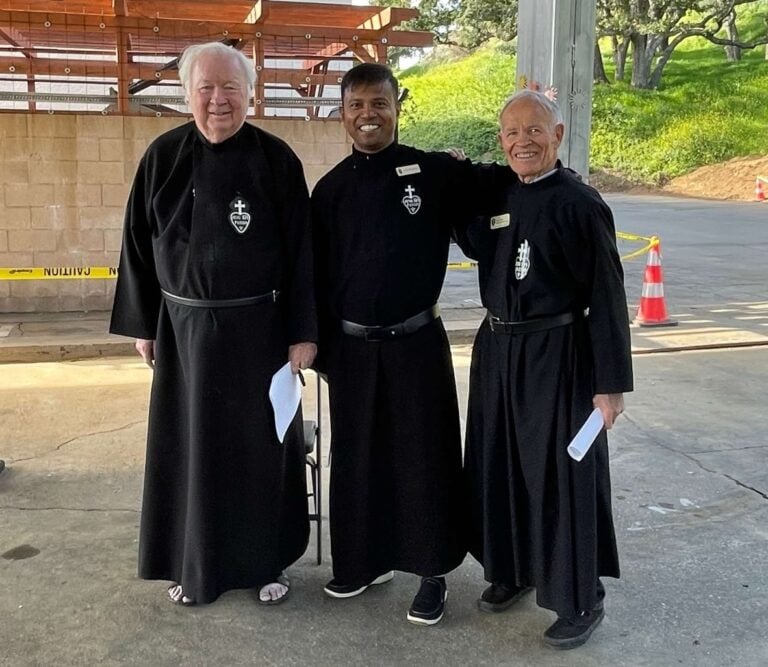
In this reflection on the Fourth Sunday of Lent, Fr. David Colhour, CP, invites us to reflect on community and service as essential parts of a life of faith.
Community moves us beyond ourselves and our selfish tendencies. It asks us to become part of something larger than ourselves. Faith was never meant to be lived alone. From the early Church to today, we are called to live as one body, supporting one another and serving the world in love.
Watch the full reflection and continue our Lenten journey.
Introduction: The Fourth Sunday of Lent
Good morning and happy Sunday. Welcome to the Fourth Sunday of Lent. It’s good to be with you as we take yet another step forward in our Passionist retreat as we reflect on the theme “From 12 to 3 p.m.” — the sacred hours of Jesus on the cross. I’m Father David, and as we continue this theme this week, we enter a new area of reflection: service and community.
In week one, we formed our hearts in prayer. In week two, we loosened our attachments through fasting. In week three, we opened our hands in almsgiving. Now week four asks us an important question: How are we living together?
Faith Is Never Lived Alone
So I have to ask: How do you live your faith? Who are the most significant people in your faith community?
From the earliest days, faith was never a private devotion. Jesus gathered twelve apostles, and then many other disciples. In the Acts of the Apostles we hear how the community lived “of one mind and one heart.” Even Paul, on his missionary journeys, was never alone. If you read closely, you notice that he always traveled with companions who helped him in the mission.
Moving beyond the apostolic era, the movement toward monasticism emphasized people living their faith together. Throughout the centuries of religious life and religious orders, the question has remained the same: How do we live our lives together in Christ?
Living together gives us the motivation to witness to who Christ is. The call to community is very strong.
The Witness of Catechumens
Perhaps you were among those who last Sunday witnessed or prayed over catechumens entering the Church. Do you realize how deep that tradition goes?
Where I was, there were thirty young people coming into the Church. In that faith community they were saying, “We want to be part of you.” As the entire assembly extended their hands in prayer over them, there was a powerful sense of unity within the Church. Standing before the community, they were asking for our blessing.
This tradition goes back to the very origins of Lent. It was a time when faith communities prayed intensely for catechumens and focused deeply on baptism.
At that time, Constantine had just legalized Christianity, and thousands of people were entering the faith. But they did not simply walk in and say, “Now we are Christians.” They went through a time of conversion and formation.
Then, on the night of the great Easter Vigil, they were welcomed into the Church. Lent became a season of preparation—not just for the catechumens, but for the entire community.
Lent as a Communal Journey
If a community is welcoming so many new believers every year, the community itself is constantly changing and growing.
Catechumens and the faithful received instruction together. Together they fasted, together they prayed, and together they served others.
There was also another element: those who were known as notorious sinners would sit in sackcloth and ashes, publicly asking to be welcomed back into the community. They were saying, in effect, “I want to belong again.”
In the early Church, Lent included longer Scripture readings, psalms, night vigils, teachings, sermons, and constant intercessions for catechumens and penitents. It was also a time of intense fasting. In fact, fasting occurred every day of Lent, and many people fasted completely on Good Friday and Holy Saturday.
Community Draws Us Beyond Ourselves
The gift of community is that it moves us beyond ourselves and our selfish tendencies. It asks us to become part of something larger than ourselves.
That can be difficult in a culture that often glorifies individualism.
One thing that has impressed me in recent years is the emphasis on service in Catholic school systems. Confirmation programs often require service hours for young people preparing for the sacrament.
But the deeper question is this: Can you discover within yourself the goodness of doing something for others? Can you help someone not for personal gain, but simply out of generosity of heart? Can you sacrifice for others?
Hopefully those service experiences help young people realize something profound: there is something deeply good about stepping beyond ourselves and serving others.
The Challenge of Our Technological Age
Lent reminds us that faith cannot remain individualistic. It is meant to test and strengthen the spiritual life of the entire community.
Today we live in a world filled with constant conversation about artificial intelligence. Every day there are articles about AI. Sometimes it seems people have better relationships with their computers than with their own family members.
The danger is that we may begin to rely on computer systems for the kind of interaction that only human beings can provide.
Computers can give us incredible access to information and data, but they do not have a soul. AI can even write beautiful prayers, but AI cannot pray for you, because it does not possess a soul.
We need community. And community needs us.
The Paradox of the Lenten Practices
We need to be people of service, and others need our service. This is the sharing of gifts.
I would argue that we do not fast in order to become holy. We fast and discover that we are hungry for Christ.
We do not give alms to become generous. We give and discover that everything we have is a gift.
We do not pray to manufacture intimacy with God. We pray and discover that we are already held in the arms of God.
We do not serve to prove that love exists. We serve and discover that love has already found us.
The practices of Lent do not produce Christ—they reveal Christ. That is the great paradox.
Christ at the Center of Lent
We do not practice these disciplines so that God will recognize us more or love us more. The paradox is that when we finally step out of our own way, we discover that Christ is already deeply present.
Christ must be at the center of Lent.
Otherwise, prayer without Christ becomes talking to ourselves.
Fasting without Christ becomes dieting.
Almsgiving without Christ becomes self-promotion.
Service without Christ becomes activism.
Community without Christ becomes mere socializing or networking.
None of those things transform us.
But with Christ, prayer becomes communion.
Fasting becomes freedom.
Almsgiving becomes love.
Service becomes gift.
And community becomes the Body of Christ.
Belonging to Christ
Lent is not about becoming a more disciplined person. It is about discovering in a new way that we belong to Christ—and Christ is in our midst.
I keep you in my prayers this week, and I invite you to join our Saturday morning gathering for more communal reflection.
Have a blessed week. And remember: the cross was not efficient, comfortable, or convenient. Yet it is where we encounter Christ most profoundly.
May this week of Lent be a profound blessing for you.