What does it truly mean to be a disciple of Christ?
In this reflection on the Fifth Sunday of Lent from Fr. David Colhour, CP, we explore how discipleship goes far beyond belief or admiration. It’s about transformation, being shaped by Christ in every aspect of our lives.
Through scripture, reflection and real-life insight, this message challenges us to ask: Are we simply fitting Christ into our lives, or are we allowing him to change us?
Take time this week to reflect on your own journey of discipleship.
Introduction: A New Week in Lent
Good morning and happy Sunday to you. Once again, we move into another week of our Lenten series from 12:00 to 3:00 p.m. Without getting into a lot of history, let’s jump in and spend some time today reflecting on the theme of discipleship.
The Wrong Question We Grow Up With
When I was a child, maybe you had the same experience, the big question adults would ask was, “What do you want to be when you grow up?” That question is nearly impossible when you’re five or six. You don’t understand the world and you certainly don’t have a life plan.
It was probably not until my 30s that I realized that isn’t the real question. The deeper question is this: under whom do you want to study?
Learning Through Relationship
When it comes to mastering a craft or skill, you don’t simply collect a degree. You find someone whose wisdom, discipline, and vision you admire. You watch how they think, how they work, and how they approach challenges.
Over time, you begin to absorb their habits, instincts, and work ethic. Their example shapes how you live and practice that craft.
What Discipleship Really Means
This is how discipleship has always worked. A disciple does not simply gather information. A disciple stays close to the teacher, learning through observation, correction, and trust.
Eventually, something of the teacher begins to take root within them. They are changed from within. They begin to see the world differently, through the eyes of the one they follow.
That’s why in fields like art, music, architecture, philosophy, or theology, people often say, “I studied under…” They name a person, not a school, because it was the relationship that formed them.
Discipleship in the Time of Jesus
At its heart, discipleship means becoming a learner who follows the teacher with their whole life. The word disciple comes from the Latin discipulus, meaning student or apprentice.
In the time of Jesus, a disciple didn’t just study ideas. They walked with the teacher, listened closely, imitated their way of life, and were shaped through relationship.
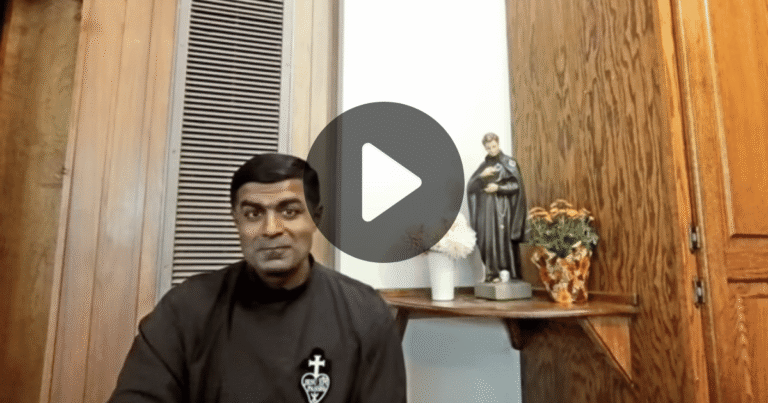
Behind me is an icon of men and women who lived this reality. These Passionists allowed Christ, especially in His crucifixion, to transform their lives completely.
We can be disciples of more than one. As Passionists, we are disciples of St. Paul of the Cross, who himself was a disciple of Jesus.
The Call of the Gospel
Two Gospel passages come to mind. In Mark 8:
“Whoever wishes to come after me must deny himself, take up his cross, and follow me.”
And in Luke 9:
“No one who sets a hand to the plow and looks back is fit for the kingdom of God.”
If those are your starting points, they can feel overwhelming. But Jesus doesn’t begin with high expectations. He begins with a call.
The Attraction of Christ
There is something compelling about Jesus. People begin asking, “Who is this?” There is integrity in His words, authority in His teaching, and a mysterious power about Him.
He draws people in.
Sometimes people describe Jesus as stern or judgmental, but that image does not match the Gospels. The Jesus of the Gospels shows genuine care, authority, and a mysterious presence that attracts people.
That is the Jesus we are meant to be drawn toward.
Formation Through Following
The disciples begin to learn from Him. They take on His wisdom, His values, and His vision. Eventually, He sends them out: “Heal the sick. Raise the dead.”
As they go, their confidence grows. Their lives take on a completely new direction.
This transformation requires trust and respect, and it does not happen overnight. It unfolds over time.
Imagining the Cost of Discipleship
Imagine the conversations the apostles had with their families.
Picture Peter’s father saying:
“Simon, fishing is not a game. This boat feeds your family. Your grandfather worked these waters, and I taught you this trade. You cannot simply walk away.”
Or James and John’s father asking:
“What do you mean you’re leaving? The boats don’t run themselves. Who is this teacher that you would leave everything behind for him?”
Incomplete Transformation
Even later, when Jesus is on the cross, it is mostly the women who remain. The men are absent. Their transformation is not yet complete.
As Mark’s Gospel suggests, it is the encounter with the risen Christ that finally brings it to completion.
Discipleship in Today’s World
In our modern world, we have to ask: have we made discipleship easier than Jesus intended?
We live in a culture that values comfort, independence, and control. In that environment, discipleship can become an idea instead of a commitment.
We may admire Christ’s teachings but hesitate when they demand something from us.
A Harder Question
So the question becomes: are we fitting Christ into our lives, or are we allowing ourselves to be shaped by Him?
Following Christ is not the final goal. The goal is transformation, becoming like Christ.
The Danger of Partial Discipleship
Many people settle for partial discipleship. We accept the parts of Jesus’ teaching that comfort us and avoid the parts that challenge us.
Sometimes this is called “cafeteria Catholicism.” We take what we like and leave the rest.
But isn’t that exactly why Lent exists?
Lent: A Time for Transformation
Lent is about purification and transformation. It is about coming to know Christ more deeply.
As we recognize God’s loving presence at the core of our lives, we begin to change. Distractions lose their importance. Our prayer deepens into trust, even when it challenges our personal desires.
Final Reflection
Everyone is being formed by something, whether it’s culture, fear, success, power, or comfort.
But discipleship asks a harder question:
Are you admiring Christ from a distance, or is Christ truly shaping your life?
Have a blessed week. Keep reflecting on discipleship in your life. God bless you.