Palm Sunday marks the beginning of Holy Week—a journey from celebration to the cross.
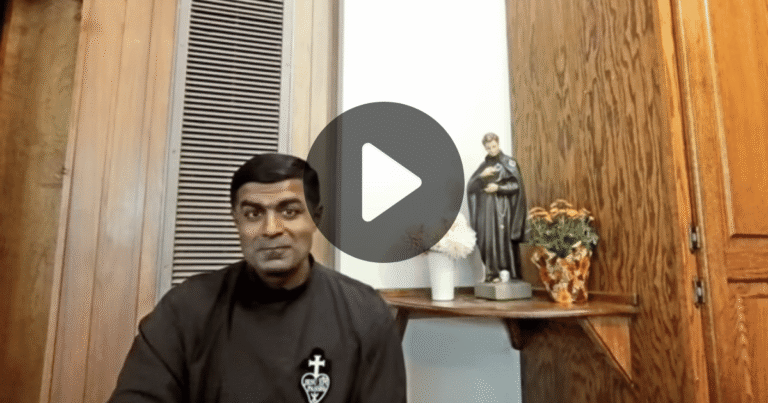
In this reflection, Father David Colhour, CP, explores the meaning of the Incarnation, suffering love, and the powerful connection between Christ’s Passion and Mary’s compassion. Through real-life examples and spiritual insight, we are invited to see where we stand in the story of Holy Week.
As the crowd moves from “Hosanna” to “Crucify Him,” we are challenged to move beyond the crowd and stand at the foot of the cross.
When you stand at the foot of the cross, you won’t be alone.
Fr. David Colhour, CP
This transcript has been prepared for clarity, accessibility, searchability and readability, though minor variations from the original video may occur.
Entering Holy Week
Happy Palm Sunday, Passion Sunday. We entitled this series “From 12 to 3 p.m.” because Lent is supposed to prepare us for active participation in the death and the resurrection of Christ. And today, Palm Sunday, we literally cross the threshold through the doorway that leads us to Holy Week.
The Incarnation: God Becomes Human
And so, as we start looking at and reflecting upon the last few days of Jesus’s life and His death, I want to back up to something just as important: the fact that He was born. The Christmas story, the Incarnation.
The Incarnation is about God becoming human, taking on human flesh, walking and talking, having a personality, and experiencing all the joys and limitations that go with being a human person. At Christmas, we rejoice in that gift.
But what would have happened if, in the Incarnation, when God became flesh, He had said, “I’m superior to human beings. I choose to live better than human beings”? There would have been something within us that rejected that—“God, You just don’t understand.”
But we never see that with Jesus. What we see is someone who submitted Himself to the struggles, the pain, and the hurtful parts of humanity. That’s how Jesus was born—rejected, with no room in the inn. That’s how He lived His life—with people who needed His help, people who prayed from the depths of their souls. So why would it be any different as we move into Holy Week and how He died?
The Way Jesus Chose to Die
Everything that is born in this world eventually has to die, and Jesus had to die. He was human. He could have said, “I’m going to be superior to others,” or “I’m going to die teaching others a better way to die.” Which, paradoxically, He kind of did.
But if you notice what He does, He allows the darkness of humanity to completely surround Him. Jesus doesn’t have an easy life, and He doesn’t have an easy death—and He does that purposefully.
He does that so that no one could ever say, “Jesus had it easy.” His life wasn’t easy. His death wasn’t easy. He died a cruel, violent, unjust, bloody, brutal, publicly shameful kind of death.
If you had stood there that day and watched Jesus die, you wouldn’t have called it holy. You would have called it what it was—cruel, violent, unjust. And yet, that is exactly where God chose to reveal love.
Suffering Love and Agape
What is it that causes suffering and love to fit together? We often say it simply: all mothers know this—we call it suffering love.
If you truly care about someone, it leads to sacrifice. When you sacrifice, when the care of another becomes so important that you put your own agenda and well-being aside, the Bible calls that agape love. It’s the love of God. It’s the way Jesus loved.
It’s total, pure, divine love—the love of the Good Shepherd.
Jesus didn’t go around doing good things just because He was nice. His very essence was the Father’s goodness, and He revealed that goodness. When you love so deeply that you are willing to suffer, that is suffering love.
Where We See Suffering Love Today
We’re all familiar with John 3:16: “For God so loved the world that He gave His only begotten Son.”
So where do we see suffering love today? It endures and deepens through pain and sacrifice.
We see it in parents caring for children with terminal illness. In spouses caring for loved ones with dementia and Alzheimer’s. In adult children tending to aging parents, where love grows even more fierce through suffering.
It’s unglamorous work—caregiving strips love down to its purest form: agape.
We see it in parents of addicted children, agonizing as they watch their child suffer while trying to maintain boundaries and remain present. We see it in public service and social justice—in mothers who lose children to violence and become advocates.
We see it in humanitarian workers, doctors, and nurses who enter dangerous places. And we see it in everyday quiet heroism—the parent working two jobs, the friend sitting with someone in deep depression, the teacher who refuses to give up on a struggling student.
Pope Francis once said, “Do you smell like your sheep?” Are you with people, or managing them from a distance?
The Deepest Suffering: A Mother’s Loss
The greatest agony of suffering love is a mother who loses a child. It feels like the laws of the universe have unraveled, like the fabric holding everything together has torn apart.
There is no pain greater than a mother watching her son die. Every culture recognizes this as a unique loss. A mother gives life expecting that her child will bury her—not the other way around.
When that future is shattered, it is a profound sorrow—a rupture in the fabric of the universe.
Mary at the Foot of the Cross
We see this in Mary, standing at the foot of the cross—the sorrowful mother.
There’s a well-known image, especially in Passionist spirituality, the Pietà. Michelangelo’s Pietà shows Mary holding the lifeless body of Jesus in her lap—one of the seven sorrows of Mary.
For St. Paul of the Cross, the suffering of Jesus and the suffering of Mary were inseparable. The Passion of Jesus is also the compassion of Mary.
Paul of the Cross and His Mother
Paul of the Cross—whose family name was Daniel—had a mother who bore 16 children, 10 of whom died in infancy.
He learned about grief through his own mother. She was constantly pregnant, nursing, or grieving. That shaped him deeply.
Sometimes I joke that his mother was the real saint. She gave him the foundation to understand that life, suffering, God, and the cross all belong together.
He saw that her suffering became part of her prayer—not turning into bitterness, but into faith.
Mary as Queen of Martyrs
Paul called Mary the Queen of Martyrs—not because she died physically, but because her soul was pierced, just as Simeon foretold.
She endured an interior martyrdom—watching her son suffer and die while remaining surrendered to God’s will. She didn’t necessarily understand it, but she trusted. She said yes.
Paul saw this as the highest form of suffering love—a slow, sustained interior agony of loving completely, losing completely, and still saying yes.
Holy Resignation vs Mere Resignation
Paul made an important distinction between holy resignation and mere resignation.
Mere resignation says, “I’ll just get through this.” Holy resignation chooses to love within the suffering.
Mary embodies this. She stands present, faithfully choosing love in the midst of pain. It’s a subtle but crucial difference.
Palm Sunday: From Hosanna to Crucify
Today is Palm Sunday. We cross that threshold. The liturgy begins with loud hosannas and waving palms, but quickly turns into rejection—voices crying out, “Crucify Him.”
This is not just a historical story. It surrounds our lives. We hear those same voices even today.
An Invitation for Holy Week
As we go through this week, listen to the people in the story. Not just Jesus, but everyone else.
Ask yourself: Who am I in these stories? And who do I wish I were?
Bring that into your prayer.
Standing at the Foot of the Cross
It’s easy to stand in the crowd. But Mary invites us somewhere else—to stand at the foot of the cross.
And one thing I’ve learned is this: when you stand at the foot of the cross, you won’t be alone. It is a beautiful presence.
Closing
I’m Father David. Have a blessed Holy Week. And don’t forget to say an extra prayer for the catechumens on their faith journey. This is one of the biggest weeks of their lives.
God bless you. See you next Sunday.