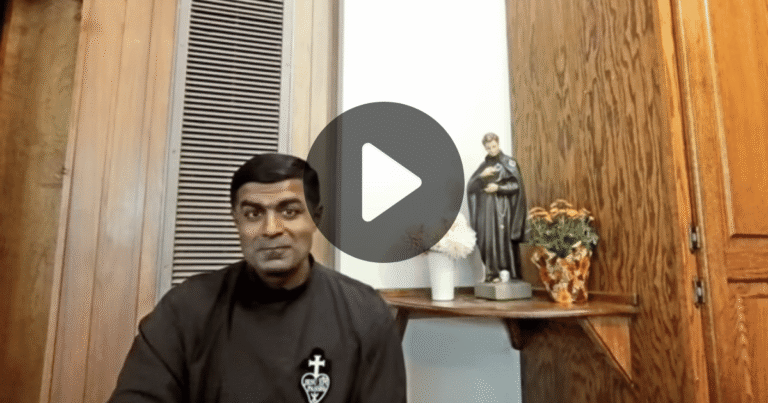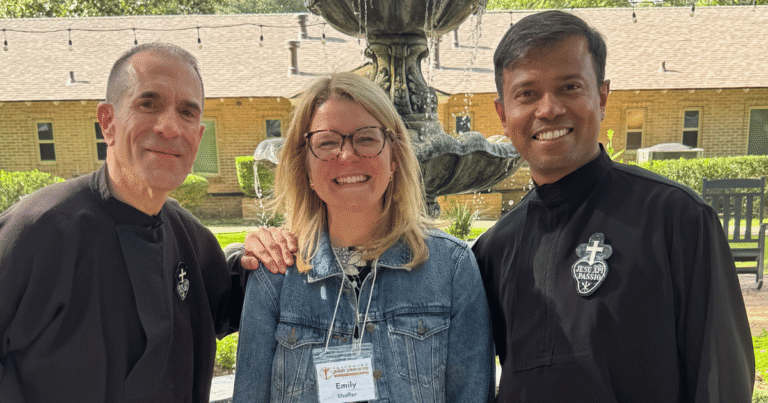
In many ways, the Passionist charism reflects the life of the small town of Isinya, and where there are differences, Father Eliud Kiuma Otunga, CP, dispels fear and offers comfort with the message of the Cross.
In the Kenyan culture, suffering is understood in two ways. First, a person suffers in retribution for past bad, selfish, vicious actions or as our fate from family history.
“When I look at our Passionist charism and teaching, we understand that Jesus suffered on the Cross for the sins of people,” shares Father Eliud. “It can follow the first African belief. In the Passionist sense, though, the suffering is taken up by Christ.
“Christ has taken our suffering and has relieved us of it. For the second belief, that suffering is our fate, and we cannot recover from it. The Passionist charism changes that mentality. You are only responsible for the things that you have done.”
Fr. Eliud Kiuma Otunga, CP
Suffering also comes from calamities and sickness. “The suffering of Christ on the Cross tells us that suffering is part of life, and we have to embrace it,” Father Eliud explains. “It is a form of seasoning. Once we come through it, we are healed. If you are loved by God, you will suffer and get stronger.”
Suffering is like a fire that burns gold: the fire does not consume the gold but melts and purifies it. After the process, the gold is refined and pure.
Extended family systems in Kenyan culture provide support and are similar to Christian communities. Elders are the head of families, like the Church hierarchy.
Families provide personal history and legitimacy in marriage or when moving to a new community. Personal identity is shaped by the community. Children belong to the whole clan, and everyone raises the children.
Father Eliud sees many similarities in the Church.
“In Kenya, our model of the Church is ‘domestic.’ We look at a domestic church as a family. In that structure, we have a small Christian community that is the basis of the parish. This helps us easily educate people to become God’s children,” he explains. “The family becomes the Church, and the small Christian community becomes the extended family. The parish becomes the big clan of different extended families. We have to balance the two – the biological family and the religious family.”
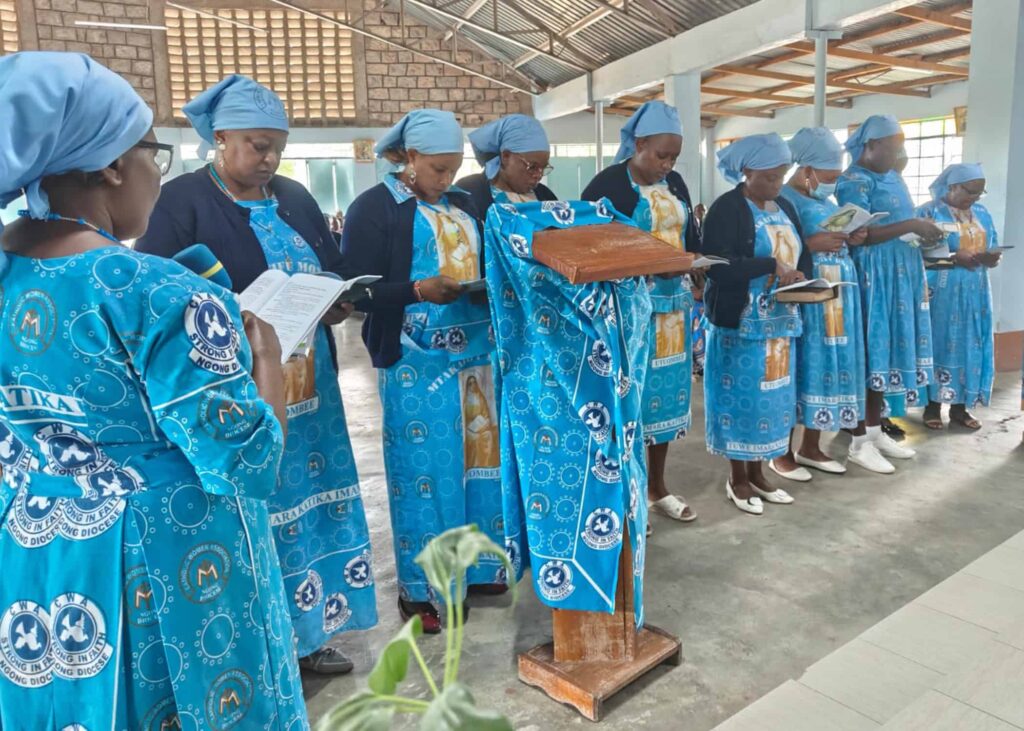
In families, authority and power are held by the male elders, which continues even after death. Young people must always obey elders. The young cannot even correct older members in mistakes, and elders do not apologize.
Power and authority differ in the Passionist community. “St. Paul of the Cross came down on his knees every Friday begging for forgiveness,” says Father Eliud. “In our formation, it is important to ask pardon for mistakes. People take authority not for power or dominion but for service.”
Respect for elders plays an integral role in how the culture understands death.
“The question of death is very interesting. If someone dies, it is believed that this person turns into a spirit. And the spirit of the deceased takes on a magnanimous disposition to become a guardian to those who remain. This is why rituals are celebrated to appease and honor the spirit before burying the person. If the spirit is not taken care of well, the spirit will punish,” he explains. “The spirit is known to live, see and hear. Sometimes the spirit can come back to rescue or punish.”
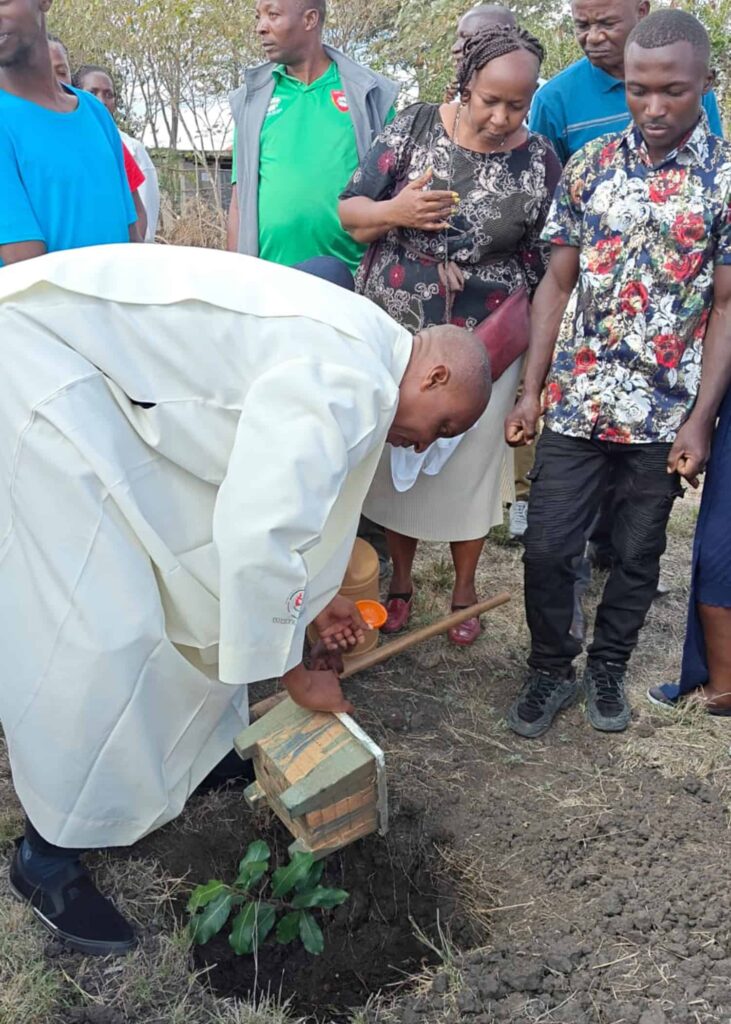
Father Eliud has found the Passionist emphasis on the Cross and resurrection very helpful in dispelling fear about what happens after death.
“People who die in Christ are resurrected. The resurrected person is a perfect soul and possesses a glorified body. That perfect soul cannot punish us,” he tells those who worry about death. “The death of a Christian does not end in oblivion but in newness. We tell them a resurrected person lives with God, and that person will intercede for us.”
This transcript has been prepared for clarity, accessibility, searchability and readability, though minor variations from the original video may occur.
Family, Identity and Belonging
Family in Kenyan culture is deeply rooted in the extended family system. Identity is strongly connected to one’s clan, ethnic group and lineage. Even a person’s name often reveals where they come from and how others relate to them.
Belonging is reinforced through important life events such as initiation rites, marriage and communal celebrations. Elders and even ancestors play a significant role in shaping identity and guiding life.
This cultural understanding aligns closely with Christian faith, especially the idea of the Church as a family. Through baptism and formation, individuals enter into a new spiritual family where God is Father and Christ is the head.
Small Christian communities also play a central role, forming the foundation of parish life. These communities provide identity, support and a sense of belonging.
However, the Passionist charism also stretches this understanding. For religious members, there is a call to belong fully to a new spiritual family, which can create tension with strong ties to one’s biological family. Balancing these relationships becomes an ongoing challenge.
Community and Identity
In Kenyan culture, identity is shaped primarily by the community rather than the individual. A child belongs not only to their immediate family but to the entire community.
There is a strong belief that “I am because you are,” reflecting the idea that a person’s existence is deeply connected to others. Responsibility for upbringing, discipline and care is shared among the community.
This communal identity aligns well with the Passionist call to solidarity with the crucified. Being present with others, especially those who suffer, is a natural extension of cultural values.
However, aspects of Passionist spirituality such as silence, solitude and personal reflection can be challenging. These practices require stepping away from constant community interaction and developing a deeper sense of individual identity.
Authority and Respect
Traditionally, authority in Kenyan culture is closely tied to age and seniority. Elders are highly respected, and their authority is rarely questioned, even when they make mistakes.
Younger individuals are expected to show deference, often expressing concerns indirectly rather than openly correcting elders. Respect is deeply embedded in social relationships.
The Passionist charism introduces a different model of authority, one rooted in humility and service. Leaders are called to seek forgiveness, accept correction and serve others, following the example of Christ.
This creates a tension between cultural expectations and Gospel values, but also opens the possibility for a more relational and compassionate form of leadership.
Aging and Care for Elders
Aging is traditionally seen as a blessing in Kenyan culture. Those who live long lives are respected and honored for their wisdom and experience.
However, modern economic pressures have begun to change this reality. Many elderly people now face neglect, especially when they are no longer able to work or when their children are unable to support them.
This shift has created new challenges, including loneliness, frustration and insecurity among the elderly.
The Passionist spirituality of presence offers a meaningful response. Being present with the elderly, caring for them and accompanying them in their struggles becomes a vital ministry. It affirms their dignity and provides the relational support they deeply need.
Expressing Love
Love within Kenyan families is expressed through presence and practical support. Being physically present during important moments, helping with daily tasks and standing with others in times of need are key expressions of love.
Gift giving also plays an important role, reflecting the value placed on relationships.
The Passionist understanding of love deepens this perspective. Love is not only about feelings or closeness but about responsibility and sacrifice. It calls people to serve others, especially those in need, even when there is no personal attachment.
True love, in this sense, involves giving of oneself and sometimes denying one’s own comfort for the sake of others.
Religion in Everyday Life
Religion is deeply integrated into daily life in Kenyan culture. There is a strong connection to ancestors, spirits and ritual practices that shape how people understand the world.
Important life events, such as marriage, include not only Christian elements but also cultural rituals that involve blessings, instructions and connections to ancestors.
This integration can sometimes create tension with Christian teaching, especially when cultural practices conflict with Gospel values. The Passionist approach seeks to engage this through inculturation, respecting culture while guiding people toward a deeper understanding of faith.
Understanding Death and Hope
In many Kenyan traditions, death is seen as a transition into the spiritual realm. The deceased become spirits who may protect, guide or even harm the living, depending on how they are remembered and honored.
This belief can create fear and anxiety, especially when people feel they must appease or avoid negative spiritual consequences.
The Christian and Passionist understanding offers a different perspective. Death leads not to a wandering spirit but to resurrection and new life in God. The deceased do not return to harm others but live in communion with God and can intercede for the living.
This message brings comfort and frees people from fear, replacing it with hope and trust in God’s promise of eternal life.
Challenging Cultural Norms
One significant cultural challenge is the strong belief in witchcraft and spiritual causes of suffering. Illness, misfortune or hardship are often attributed to supernatural forces.
The Passionist charism challenges this by encouraging a more balanced understanding that includes both faith and practical solutions. People are guided to seek medical care, address real-life issues and trust in God rather than fear.
This shift has been life giving for many, helping them move from fear to freedom and from superstition to hope.
A Concrete Expression of the Charism
One everyday example of living the Passionist charism in Kenya is the understanding of poverty.
In many African contexts, poverty is something to overcome. It is associated with struggle and hardship, and people naturally seek to improve their circumstances.
The Passionist understanding of poverty, however, emphasizes detachment rather than deprivation. It is not about having nothing, but about not being attached to what one has, so that everything can be used for the good of others.
This perspective can be challenging, but it opens the way for greater generosity and service.
A Living Encounter Across Cultures
One of the most surprising aspects of the Passionist charism is how differently it is expressed across cultures.
For example, simplicity may be understood in one culture as extreme austerity, while in another it means living comfortably but without attachment. These differences can create tension, but they also reveal the richness of the charism.
At its heart, the charism remains the same, calling people to live simply, serve others and find God in both suffering and love.