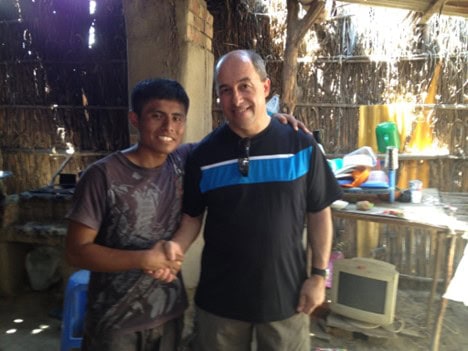
Father Michael Ogweno, C.P., lives in a small village, Jwaneng, roughly two hundred kilometers away from Gaborone, the capital city of Botswana. He is the parish priest of the Lapa La Lorato (Family of Love) Catholic Church in Jwaneng, which also serves the surrounding villages.
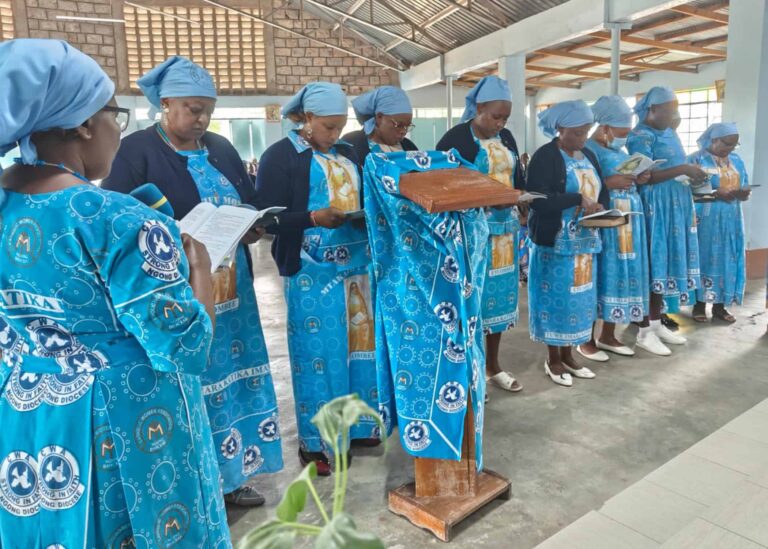
He ministers to Catholics who are without clean water or enough food, but who are full of hope, which is visible in their everyday actions. They never fail to gather in prayer every Sunday to give thanks to God for their lives.
“Where I come from, we actively believe in hope,” he shares. “There is so much we are looking forward to that we have not achieved. You have to be the change you want to see. Tomorrow we will be better than today.”
“With God, each day is an opportunity to begin again.”
Fr. Michael Ogweno, CP
The members of Lapa La Lorato (Family of Love) Parish know the power of hope. After losing their first parish priest, these faithful Catholics hoped and continuously prayed for a pastor to lead them.
Father Michael was asked to come to Jwaneng to help. God provided a joyful parish.“The people have been deprived for a number of years, but something in them said maybe something will happen and it did,” explains Father Michael. “Even though the parish was deteriorated and everything was dilapidated, people were still there. When I was asked to go, I said, ‘Here I am.’ It was not easy, because I was someplace where I thought things were going well. To go to Jwaneng, I would have to start from zero. But then I thought, if not me, who would?”
Through the sacraments; Father Michael provides hope and strength to his parishioners. In their faith and trust in God, his hope is strengthened.
“With God, each day is an opportunity to begin again,” Father Michael says. “I have seen that happening even when I go to meet people, and I think their situation is really deplorable. Then I see smiles on their faces. I come as a priest, so I administer sacraments. The sacraments are a powerful accompaniment that allows people to bring God into their lives. You see people’s faith. Real living faith.”
Their simple life helps people keep God at the center of their lives. They know that Jesus understands the pain and sorrow they experience.
“I just share the Word of God. Looking into history nobody has ever gone through hell like the only Son of God,” shares Father Michael. “He did that to give us an example and to empower us to do the same. We are to follow by taking up our crosses daily. I strongly believe God has something to say in all our human experiences. If only we pay attention a little bit, we may discover how God wants us to respond to whatever the situation is.”
Father Michael’s life changed when he came to Jwaneng.
“What surprised me most was myself,” he explains. “When I got here, I said this is doable, life can go on. My previous parish was in town and it was easy. Now if I need something I have to think twice if I really need it. I have to weigh the priorities.”

What has helped Father Michael navigate the difficulties he encounters are the people of his community and how they appreciate the gifts in their lives.
“The people have different experiences and different expectations,” says Father Michael. “They appreciate a priest to celebrate the Eucharist for them. Just for myself, I do realize that when you are in a comfortable place you take things for granted. When you are deprived of comfort, you learn to be more grateful to God for whatever you receive.”
“The good that is happening does not make news…God is still with us despite what is going on around us.”
Fr. Michael Ogweno, CP

He believes that although the world seems filled with negativity and evil, we should watch for the good and continue to hope.
“The good that is happening does not make news. I think the presence of God makes people wake up and believe there might be something better,” shares Father Michael. “That has also nurtured hope in me. Maybe we need to tune in to what God is saying and doing. It does not make news, but God is in there. God is still with us despite what is going on around us.”
Full video interview
Question: Do you see hope as an active state, a prayerful one, or both? Is it more meditative? Is it a call to action?
Father Michael: For me, it is both. When we talk about hope, especially where I come from, we actively live in it. There is so much we look forward to that we have not yet achieved, and we know that to reach our goals, we must get involved. As the saying goes, you must be the change you want to see. Hope is not passive—it calls us to act and make life better.
Why We Need Hope
We all need hope because, no matter our situation, there is always something we long for. Each of us needs something different, but we all share the desire for tomorrow to be better than today.
Restoring Hope in the Parish
My parish had been closed for a time, and when I returned, I found that people had not completely given up. Some left, but many stayed, still gathering and praying together. Their persistence reminded me that with God, each day is a new beginning. Hope allows people to say, “Let us keep going; tomorrow something will happen.”
As a priest, I nurture hope by sharing the Word of God. I believe God has something to say in every human experience. If we listen carefully, we will discover how He calls us to respond. The sacraments, too, are a powerful sign of God’s presence. They bring strength and peace, no matter the circumstances.
Returning to a Closed Parish
When I was asked to return to this parish, it was not an easy decision. I had been in a comfortable place where things were going well. Moving felt like starting over. I wondered, “Why me?” But then I reminded myself—if not me, then who?
I found encouragement in Scripture. None of God’s people were ever given an easy task. Even Jesus endured suffering. He said, “If anyone wants to come after me, let them deny themselves, take up their cross daily, and follow me.” Hope requires perseverance.
Discovering Joy in Simplicity
At first, I felt like I was being sent to a difficult place. Yet through prayer, I found peace. I realized I could live simply and be content. I used to rely on conveniences like television or nearby shops, but now I think twice about what I truly need. This experience has taught me gratitude—for life, for faith, and for the people around me.
The community is deeply appreciative. They cherish the Eucharist in ways many of us take for granted. Even without much, their joy and faith are vibrant. Seeing that has changed me.
Challenges and Gratitude
Life here has its challenges. The water is undrinkable, and many cannot afford clean water. My bishop gives me the equivalent of $400 a month, which must cover everything—water, food, petrol, and clothing. Still, I am grateful. I have learned to be frugal and to stretch what I have, and that simplicity brings peace.
Hope from the People
Two catechists volunteer alongside me—one older woman and one younger. They receive nothing in return, yet their dedication is unwavering. Their faithfulness and joy inspire me. When I visit parishioners, even those in mourning or deep poverty, their smiles encourage me. Often, I feel I have little to give but my presence, and yet they are profoundly grateful for that. It reminds me that walking beside others—ensuring no one walks alone—is one of the greatest acts of hope.
Staying Hopeful Amid Chaos and Poverty
It is easy to feel overwhelmed by negativity in the news, but I believe goodness still fills the world—it simply does not make headlines. Even in poverty, people smile and live with joy. That must be the presence of God. God’s quiet work may not make the news, but it is real and visible in everyday acts of kindness and endurance.
Being a Pilgrim of Hope
You do not need to go to Rome to be a pilgrim of hope. A pilgrimage is more than a journey to a holy place—it is an inner transformation. Hope begins as a shift within the heart: moving from despair to faith, from darkness to light. Some people have everything yet still feel hopeless, while others with very little live with joy. Hope is a spiritual, mental, and emotional journey we all must make.
The Supplies for the Journey
To be pilgrims of hope, we need three things: faith, trust, and charity.
Faith in a higher power, trust that God has our best interests at heart, and charity toward others—sharing not only material goods but also our time, our compassion, and our willingness to listen. True charity is about connection.
We must care for others as we care for ourselves. When we lift others, we ourselves are lifted. Joy comes from love, not possessions.
God’s Lessons in Loss and Trust
I have known deep loss. My father died in 1981 and my mother in 1994. Their deaths shook my faith so deeply that I nearly left the priesthood. I was angry with God. I took time away and lived alone, praying and reflecting. During that solitude, I realized that God does not change His mind—when He calls, He provides what we need to continue.
Those trials taught me to trust that God leads even when the path is uncertain. Like the Israelites at the Red Sea, I hear a voice saying, “Keep marching on.” I have faced many challenges since, but God always provides. Through kind people and unexpected help, He reminds me that He is with us until the end.