

Gathering companions on the journey
Deeply believing that “The world lives unmindful of the sufferings of Jesus, which are the miracle of miracles of the love of God,” Paul Francis Daneo set out to establish a religious order that would be dedicated to spreading the message of the love of Christ Crucified.
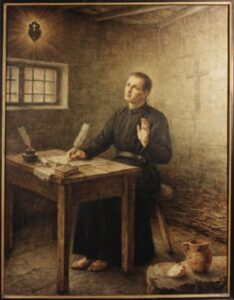
Paul was determined to gather companions who would live together in community and promote this new message.
From 1720 to 1741, Paul spent twenty-one years in humble service as a hospital chaplain and traveling preacher, persevering quietly despite official Church rejection, until he finally received papal approval to found his religious order, The Congregation of the Passion of Jesus Christ.
He was later canonized as St. Paul of the Cross on June 29, 1867.
The beginnings of the Passionists
Paul Francis Daneo is born in Ovada, Italy
Paul of the Cross is ordained and settles in Monte Argentario, north of Rome, a year later.
The Rule of Common Life is approve, allowing public profession of vows.
Pope Clement XIV gives approval for the Passionist Congregation, including the gift of the Monastery and Basilica of Saints John and Paul in Rome.
Paul of the Cross dies, leaving the Passionist Congregation as a tiny seed in the Papal States.
St. Paul of the Cross is canonized by Pius IX and is buried in a special chapel at the Basilica of Saints John and Paul.
The Passionists Come to America
At the request of Bishop Michael O’Connor of the Pittsburgh, PA diocese, the Passionist Community in the United States began in Pittsburgh, Pennsylvania, in 1852 with the arrival of four devoted missionaries: Fr. Anthony Calandri, CP; Fr. Stanislaus Parczyk, CP; Fr. Albinus Magno, CP; and Br. Lawrence DiGiacomo, CP.
Despite their limited proficiency in English, they quickly gained the trust and admiration of the local community. Their parish missions were well received, and before long, they attracted many young men interested in joining the Passionist community.
Fr. Stanislaus Parczyk, CP, fluent in both Polish and German, was appointed pastor of a nearby German-speaking parish, strengthening the Passionist presence in the area. Br. Lawrence, DiGiacomo, CP, who had previously accompanied Fr. Peter Magagnotto, CP, on mission in Nevada, was instrumental in fundraising efforts for the new foundation. In 1864, he was assigned to a mission in Mexico, but sadly, he contracted a tropical disease and passed away in New York the following year.
Establishment of Holy Cross Province
As the Passionist community grew and the territory became too vast for one province, in 1902, under Fr. Fidelis Kent Stone, CP, and the provincial leadership of St. Paul of the Cross Province, a decision was made to establish a new province.
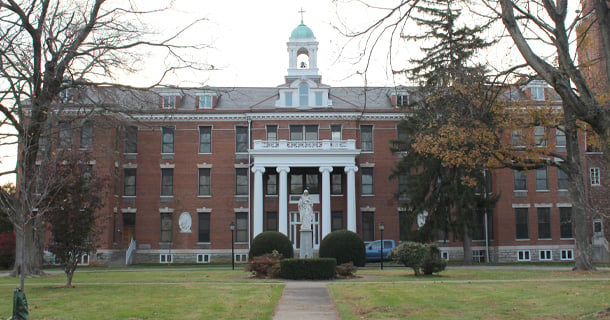
In 1906, Holy Cross Province was established. The first Provincial was Fr. Charles Lang, CP. The Provincial Office was located at Sacred Heart Monastery in Louisville, Kentucky. The Provincial Office moved to Immaculate Conception Monastery on the northwest side of Chicago when construction was completed on the building and has remained in the Chicago area since.
Over the next several decades, Holy Cross Province expanded, founding retreat centers, parishes and schools established across the South, Midwest, Southwest and the West Coast of the United States.
A Global Presence
Holy Cross Province has been blessed with growth both in the United States and around the world. In 1952, missionaries were sent to Japan, followed by a mission to Korea in 1963. Both of these communities grew strong over the years and eventually became independent Passionist Provinces.
In 1981, the Holy Cross Province responded to a call to begin a mission in southern India. That mission flourished, with many local vocations and outreach programs, leading to the establishment of St. Thomas the Apostle Vice-Province in 2013.
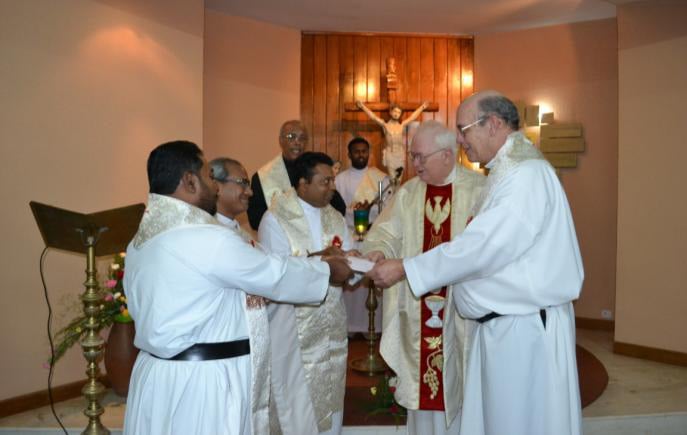
In addition to these efforts, Passionists from Holy Cross Province have also served in China, Germany, the Philippines, Jamaica (West Indies) and Haiti—continuing the mission of St. Paul of the Cross to bring the message of God’s love to the world.
This global outreach continues to be a testament to the missionary zeal and commitment of the Passionist Community.

Collaboration between vowed and lay
While we celebrate the growth of our ministries both in the United States and around the world, we are especially excited about new and innovative forms of ministry. Over the past 20 years, Holy Cross Province has seen a remarkable spirit of collaboration between vowed Passionists and lay men and women.
Passionist religious have actively welcomed lay people to share in the mission of advancing the charism of St. Paul of the Cross, founder of the Congregation of the Passion.
Today, increased formation of vowed and lay in Passionist spirituality ensures the ongoing vibrancy of the Passionist Mission for decades to come.